Thursday, May 04, 2006


I've never read a book that seemed as easily written as Jeffrey Ford's The Girl In the Glass. That isn't to say that it's a simple book. It was a breeze to read. Ford just has a way with storytelling. After finishing Hrabal's book and beginning Manguel's the night before, yesterday morning I woke up, picked up Ford's book and headed to work. Ten hours later I was almost done with it. By 10pm I was done and left wanting more.

"I turned back to the beginning of the tale and read the first few paragraphs. It had been many years since I'd read about the demon who had created a mirror, the special nature of which reflected all of the true and good things in the world so that they seemed distorted, absurd, frightening. When the demon tried to take his mirror to heaven to show the angels their warped reflections, he dropped it and it fell back to earth, shattering into a million tiny particles. The wind blew these infinitesimal shards of evil into the eyes of two children who loved each other, and their views of the world and each other turned dark and disturbing. The image in my mind's eye of Charlotte's corpse was a shard from the demonic mirror."

More please...

The Girl In the Glass unravels like a an old mystery movie, full of carnival geeks, strong men, Mexicans acting as Indians and most importantly, slight of hand artists. Thomas Schell is a great slight of hand artist working the rich neighborhods of Long Island during The Depression. But Schell has found his niche...seances. With young Diego, our narrator, acting the part of Indian guru Ondoo and former strong man turned body guard and friend, Antony Cleopatra, working as chaffeur, Schell has made the rounds of Long Islands richest, playing on their fears and insecurities and bilking them of their dough. But when Schell supposedly sees the image of a young girl in the glass window of one of his clients, he decides to put all his effort into finding who she is. Turns out, she's the missing daughter of another rich family. The mystery unfolds with the trio employing their skills for good to find out what happened to the young girl.

Diego is telling us the story looking back on his life with Schell, whom he calls his father, and Antony. It is a story about family as much as it is a mystery with exciting characters. It's a story about how life tosses us around, leaving some of us alone in the world, only to be saved by another human. Diego was alone in the world, slowly dying in the streets during the early part of the Depression, until Schell plucked him out of the gutter and into an exciting life. This instant bond created a relationship stronger than most blood relationships I know.

I may write a little more on this tomorrow, but I just got in from my second job and I'm a bit tired. I'm going to go for now, but you can check out more on this book at the Litblog Co-op where Ford has been a guest blogger for the past few days. His blogs are worth checking the site out. You can get a sense of his writing and grasp his understanding of his subjects. He's an interesting guy and I'm definitely going tot read more of his work.

Night.

Wednesday, May 03, 2006

I had never heard of Bohumil Hrabal before last week when I read about him in different lists on recommended reading. (Thanks to Of Books and Bikes) Then I picked up Too Loud a Solitude. From the first paragraph on, I knew that I'd finish the short novella (redundant?) in a sitting, no problem.

For thirty-five years now I've been in wastepaper, and it's my love story. For thirty-five years I've been compacting wastepaper and books, smearing myself with letters until I've come to look like my encyclopedias-and a good three tons of them I've compacted over the years. I am a jug filled with water both magic and plain; I have only to lean over and a stream of beautiful thoughts flows out of me."

Like the compactor that he lovingly employs, Hant a, the narrator, repeatedly pounds away "for thirty-five years now, I've been compacting old paper and books." But not all the books end up compressed into waste. Some, many, find their way into the hands of Hant a, the safe keeper of words. Goethe, Shiller and Nietzshce are saved from the ruins by their supposed executioner and brought back to his cramped apartment where they'll live among a throng of thousands.

Tons of books are stacked precariously above Hant a's head. The sheer weight of them would crush him to death. "I've been bringing home books every evening in my briefcase, and my two-floor Holesovice apartment is all books: what with the cellar and the shed long since been packed and the kitchen, pantry, and even bathroom full, the only space free is a path to the window and stove. Even the bathroom has only room enough for me to sit down in: just above the toilet bowl, about five feet off the floor, I have a whole series of shelve, planks piled high to the ceiling, holding over a thousand pounds of books, and one careless roost, one careless rise, one brush with a shelf, and a half ton of books would come tumbling down on me, catching me with my pants down."

I imagine my apartment like that if I didn't have roommates, or had a job in which I could afford more books.

The thing about the book that caught me by surprise though isn't the humor of it, but rather the baseness of the bibliophilia. So many times when I read about a love of books or the all consuming passion for books and reading, it's about old, nostalgic libraries and reading in the confines of a favorite comfy chair. Hrabal is able to show the humanity of books. How books are so easily discarded after they're used, even if only once. It could have been written by Bukowski. Bibliophilia is a compulsion and can lead to severe effects on one's life. I don't think Hrabal is making this strong a point, it's just something I thought about while reading about Hant a. While writing that sentence, I was tempted to write, lonely Hant a, but I can't write that someone is lonely when they have visions of Jesus and Lao-tze while working

"I saw Jesus as a romantic, Lao-tze as a classicist, Jesus as the flow, Lao-tze as the ebb, Jesus as spring, Lao-tze as autumn, Jesus as the embodiment of love for one's neighbor, Lao-tze as the height of emptiness, Jesus as progressus ad futurum, Lao-tze as regressus ad originem."

My mind wanders at work as well, but I'm usually trying to decide what I want for lunch. Burger King as the tasty choice, Souper Salad as the healthy choice. Is Hant a lonely? Some may see him as such. I tend to see him and people like him, as the mystics of the modern world...or maybe they're just crazy.

Just read:
Bohumil Hrabal Too Loud a Solitude
Jeffrey Ford The Girl In the Glass

Now reading:
Alberto Manguel A History of Reading

Listening to:
Blue Jays at the Red Sox on a soggy Wednesday night in the Fens

Tuesday, May 02, 2006

Now I'm just pissed at the publishing industry and feel sorry for her. She seems to have been a kid that was in way over her head. How come I feel this wouldn't have happened under the eye of editors like Max Perkins or Sterling Lord? Should we be blaming Little, Brown? I am.

Monday, May 01, 2006


The concept behind Marilynne Robinson's Gilead is interesting and she succeeds in the most part. The novel is written as a long letter being written by a 77-year-old minister in Gilead, Iowa, to his 7-year-old son. I like how this man, who is in the slow process of dying, takes time to write a beautiful letter to his son. Part eulogy, part spiritual guide and part genealogy, the letter tells the story of the Ames family focusing on the three generations of preachers. "I'm trying to make the best of our situation. That is, I'm trying to tell you things I might never have thought to tell you if I had brought you up myself, father and son, in the usual companionable way."It was a heartfelt, old fashioned story, but I wasn't interested in it. I kept on waiting for some passage to blow me away, or some great fatherly advice to hit home. The writing was sparse and tolerable, but I never became engaged in the story. John Ames is leaving his legacy in words, yet he never seems to say or tell anybody what he really feels. Do as I say, not as I preach? Really?

Ames is a genteel man with an obvious good heart. At least according to him. I'm alright with that because one of the more difficult things to do in art is to look at yourself critically and express your faults for the world to see. However, Ames wasn't writing for the world, he was writing for his son and only his son. Shouldn't this have made him more willing and able to point out his own flaws? And I can only hope to have a wife as saintly as his, but she seems too good to be true. I guess to a minister, he sees her as a blessing. I know we all wish/hope someone would look upon us in such a way. Unrealistic? I don't know. According to Ames, her only fault was in the way she spoke when they first met. Adding to her saintliness, Ames doesn't think of it as a flaw. He sees her poor vocabulary and grammar as an endearing trait.

What Ames and Robinson in effect, were able to do, was preach without being too religious. Ames used "the Scripture" as a way of explaining his feelings instead of using it to tell us how to feel. In fact, I was overcome with how simple he made religion seem. There was no heavy handed preaching, no speaking down to his son, i.e. the reader. Religion in this setting and in Ames's life was a connection to the past, to his father and grandfather. I envied this relationship even if I don't envy their religion. Ames doesn't know if he's going to be the last in the line of ministers and he doesn't much care. He turns his intentions on letting his son know something about his family before their story was lost forever, before their history was forgotten. Now that it's written, it is so.

Gilead had a lot of hype and I can see why. There were some parts that spoke the truth as I see it and I like the idea of sitting down as an old man and writing my son or grandson a letter in this fashion. For making me think of the future and dream of a day when I can sit with my child and tell him about his grandfather and grandmother, I thank Robinson. I know I'll have some stories to tell.

Now reading:
Bohumil Hrabal Too Loud a Solitude
Alberto Manguel A History of Reading

On deck:
Umberto Eco The Mysterious Flame of Queen Loana
I did it. What did I do you ask? Not only did I go to the library, but I borrowed four books. That's right, I borrowed books from a library. How novel of me. You see, I'm a buyer. I like being able to dog ear pages, write in the margins, loan them to friends and generally like seeing them sitting on my bookshelves for eternity as dust forms around their yellowing spine. Today I broke from my comfort zone (what that is, I don't really know) by renewing my library card and then took out the much blogged about A History of Reading by Alberto Manguel, Marginalia by H.J. Jackson, The Girl in the Glass by Jeffrey Ford and Too Loud a Solitude by Bohumil Hrabal.

Thanks to Dorothy at Of Books and Bicycles for the for the Manguel book. I already know I'll dig it.

Sunday, April 30, 2006

I planned on writing a post on Gilead tonight, but I ended up going out again. For those of you counting at home, that's three nights out in a row. For normal people I know that's nothing big, but for a homebody like myself, it's a big deal. Tomorrow will come my first real post on Robinson's novel.

"But I've developed a great reputation for wisdom by ordering more books than I ever had time to read, and reading more books, by far, than I learned anything useful from, except, of course, that some very tedious gentlemen have written books. This is not a new insight, but the truth of it is something you have to experience to fully grasp.

Thank God for them all, of course, and for that strange interval, which was most of my life, when I read out of loneliness, and when bad company was much better than no company. You can love a bad book for its haplessness or pomposity or gall, if you have that starveling appetite for things human, which I devoutly hope you never will have. 'The full soul loatheth an honeycomb; but to the hungry soul every bitter thing is sweet.' There are pleasures to be found where you would never look for them. That's a bit of fatherly wisdom, but it's also the Lord's truth, and a thing I know from my own long experience."

Thursday, April 27, 2006

As far as non-fiction goes, The Professor and the Madman was quick and easy, and thus, a highly accessible read. I haven't read anything else by Winchester, but it's easy to see why he's become such a prominent figure in the non-fiction genre. The Professor... is the story about the prodigious task of creating the Oxford English Dictionary. There were dictionaries before the OED, but none encompassed every word in the English language. Prior to the OED, dictionaries were specifically written for parts of speech. Not the OED. Even this day in age I can't imagine trying to track down a quotation of every word, citing that definition, finding the origin of the word and the first time the word was used. It's unfathomable. Yet, Doctor James Murray, a member of the British Philogical Society undertakes the assignment with great energy. He will work on the project for forty years, the rest of his life, and still fail to see it to completion.

And that's only half the story. The other protagonist is an American Army surgeon. Well, actually, he's more famous because he was a murderer. In the 1870s, the American doctor, W.C. Minor, is living an unknowingly tortured life in England when he murders a man. Deemed insane, Minor spends the next forty years or so, in a hospital (a loose term here) where he corresponds with Murray and the rest of the OED team. For twenty odd years, Minor sends in thousands of words to Murray from his two room cell just outside of London.

It's an extraordinary story that I kept thinking would make a great movie. At least if you're a geek like me, you'd enjoy a movie about the making of dictionary, but I feel most sane people would opt for another way to spend two hours of their life. Not me. Murder, books, intrigue, words, long white beards...OSCAR!


Now reading:
Marilynne Robinson Gilead

On deck:
Umberto Eco The Mysterious Flame of Queen Loana

Wednesday, April 26, 2006

I smiled tonight. It's not unusual that I smiled. Nothing out of the ordinary. But walking down Newbury at night, among the students, artists, tourists and the like, with newly purchased books tucked away in my bag, just hits me. I used to get the same feeling playing baseball. Or rather, I used to get the feeling during practice or right before the game began. Whether it was the smell of the cut grass, feeling the stitches on the ball or re-curving my hat, I would be giddy with anticipation, fear and shear joy. I don't play ball anymore, so my adrenaline has to come in other forms: literature. Do I go overboard in purchasing books? Of course. But it is what it is. Tonight, with my books hidden in my bag, I held a secret that no one else knew. In each book I am able to imagine my greatest dreams, see places I may never travel to and meet people I only wish I knew. Knowing this, feeling this, I smiled.


Books I lugged home tonight were all on sale: Umberto Eco's The Mysterious Flame of Queen Loana, Marilynne Robinson's Gilead and Jose Saramago's Double. They may have to wait a bit, but I've got them at last!
Nicole Krauss, Zadie Smith, Hilary Mantel, Sarah Waters, Ali Smith and Carrie Tiffany have made the shortlist for the Orange Prize for Fiction. Great group, tough competition, but I'm pulling for Krauss. Though I should probably read Waters, Mantel and Tiffany to make a better judgement.

Tuesday, April 25, 2006


In a three day rush, I read Carlos Ruiz Zafon's The Shadow of the Wind, savoring every word, every passage, every character. Ruiz Zafon seamlessly molded a mystery novel with a work of high literary merit...no easy feat. The book reads easily and is inundated with passages that smell of the shadowy streets and characters Ruiz Zafron so meticulously describes.

"This place was already ancient when my father brought me here for the first time, many years ago. Perhaps as old as the city itself. Nobody knows for certain how long it has existed, or who created it. I will tell you what my father told me, thought. When a library disappears, or a bookshop closes down, when a book is consigned to oblivion, those of us who know this place, its guardians, make sure that it gets here. In this place, books no longer remembered by anyone, books that are lost in time, live forever, waiting for the day when they will reach a new reader's hands. In the shop we buy and sell them, but in truth books have no owner. Every book you see here has been somebody's best friend. Now they have only us, Daniel. Do you think you'll be able to keep such a secret?"

As a reader, that's what I consider myself, a custodian of books. And I especially wish there was some place like this Cemetery of Forgotten Books that Daniel's father takes him to. Where books don't die or lose readers, they simply lie in wait for their next reader to dust of their cover and take over another imagination. Where books are held to the highest standards and require protection from the elements of society that would rather they were gone. Where books are pathways to greater adventures and mysteries.

Ruiz Zafron intricately plotted a story surrounding the disappearance of a writer's, Julian Carax, novels all being bought or stolen, only so they can be burned. A stranger with no face lurks in shadows, behind closed doors and in foreign cities, searching for each Carax novel to banish them forever. Ashes to ashes. When Daniel Sempre takes Carax's novel The Shadow of the Wind from the Cemetery of Forgotten Books, his life, and those of his loved ones, are put on a path of danger and adventure reminiscent of a Dumas novel.

I admit that I became interested in Ruiz Zafon's novel because of it's fairly soap opera-esque title and the book's cover design, but I swallowed the book whole...every last word was cooked perfectly.

Now reading:
Simon Winchester The Professor and the Madman

On deck:
Steven Heighton The Shadow Boxer

Listening to:
George Gershwin Rhapsody in Blue
Kerouac's cottage for sale - sold to the highest bidder for only $300,000?

Monday, April 24, 2006


I'm not usually drawn to family dramas or medical ethics, but if they're all as breathlessly written as Michael Byers's Long for This World, then I'd have to be more inclined to read them. I love good last pages or paragraphs of novels almost as much as the opening stanzas. I began writing about Byers by quoting his opening paragraph. And now I'm obligated by the literary gods (or demons) in my head, to quote his closing. It's from the point of view of Darren, the teenage son of the Moss family.

"But there were other things on his mind too. He too was getting ready for college, and now he felt more acutely than ever that the world was full of a sort of marvelous, overwhelming, distracting possibility; so sometimes he found himself coming into a room with a purpose, only to forget what it was, and as he stood there, suddenly adrift in the middle of a familiar room, each object around him, though mute and motionless, seemed to hold a kind of coded message for him, a vibrating potential that remained unrealized - Was this what he had wanted? Was this? - and only by retracing his steps, squinting deeply into his own mind, and then coming into the room again would he at last remember what it was he had been looking for."

The poetic prose of this novel stands out from the crowd of today's short sentence structure. I've always been attracted to long sentences when a writer can get a cadence going. When their voice can be heard and their mind, though still hidden, is unveiled, if only momentarily for us to glimpse. It is in such passages that Byers shines. In a novel that is largely based on finding a cure for Hickman's disease, a disease in which young children age at rapid rates and die of old age by the age of fourteen,Long for This World makes the reader, young or old, come to terms with mortality. Byers challenges us to imagine the lives we live, to imagine the lives we can live, to imagine the lives we will live and to imagine the lives we'll never live.

I know the difference of great literature is in the shades, but in reading Byers, I couldn't help but feel I was reading something special, by someone special...and it was a good feeling.

Now reading:
Carlos Ruiz Zafon The Shadow of the Wind

On deck:
Simon Winchester Professor and the Madman

Listening to:
Diana Krall The Look of Love
The weekend is over and I have reclaimed part of my sanity. Well, I've recaptured enough to post about Michael Byers's Long for this World a little later tonight. And if the post doesn't run too long, I'll throw in a few words about my newest read...Carlos Ruiz Zafon's The Shadow of the Wind. And now, time for some good ole cafetaria lunch.

Cheers

Thursday, April 20, 2006

Much...to...tired to post anything tonight of any value. Will try to recover and post a lil something about Byers's Long for This World. I will say that I've enjoyed it more than I thought I would. I'm not a fan of science writing in literature, but in this novel, there's only so much to keep the story going. 

Wednesday, April 19, 2006

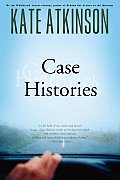
I lent a friend of mine Case Histories, thinking she'd enjoy it. I wanted someone else I know to read it so we could talk about it. Like a mini-mini-book group. What happens? She hates it of course. The writing was bad. The stories were overly sentimental. The characters, awful. Except for Jackson she says. I know we're not all supposed to all like the same books. I'm sure there would be countless books she loves that I would discard without hesitation. It's just an odd, unsettling feeling to like a novel so much and to think someone else would get caught up in the crazy, sad stories, only to have them struggle through 100 pages before closing the cover for good. Two weeks ago I gave her the book. Now, I have it back. Unread. It looks lonesome on my record player, atop Shelby Foote's Civil War trilogoy. At least it's in good company now, surrounded by books loved by their reader. Snuggled amongst Ozick, Agee and Foote. You're home now.

Tuesday, April 18, 2006

"It was a big old pleasant high school gym, built in the twenties and not much disturbed by renovation. The iron rafters met at a shallow angle at the roofline, and the tall windows were made up of a dozen big panes, each reinforced with chicken wire, and the two ancient clocks sat on opposing brick walls, ratcheting their works forward with an audible whir, his clunk. The gym smelled nostalgically of varnish, sweat, and paint, but it was not an obsolete shabby place."

Michael Byers Long for this World

The minute I read that opening paragraph, I had to buy the book and it hasn't been a let down. Talk about lyrical, Byers exudes it.

Now reading:
Michael Byers Long for this World

On deck:
Steven Heighton The Shadow Boxer

Listening to:
Baseball Tonight on ESPN

Sunday, April 16, 2006

I don't know about anyone else, but I turn to poets for answers. Love? Ask the poets. Death? Ask the poets. Life? Poets. It seems that though they may not have the answers, their thoughts on the matter are highly attuned to humananity. David Huddle is a poet. At least that's what the blurb on the back of his novel says. David Huddle may be one of the best poets I've never read, but his novel The Story of a Million Years is nothing more than a pedestrian look at married couples. I feel I've read or seen all this before. A middle aged man having an affair with a seemingly mature teen girl who's the daughter of his wife's friend. (Mrs. Robinson in reverse?) Or how about two couples in fairly monotonous relationships and their struggles to remain faithful. Huddle puts no new spin on the age old stories and leaves them nothing more than common narratives through common terrain. I expect better language from poets. I expect more from poets. I expected more from Huddle.

Friday, April 14, 2006

My first meme (which I stole from Pages Turned)

Name books you liked, one for as many letters of the alphabet as you can come up with.

All Quiet on the Western Front - Erich Mari Remarque
Balzac and the Little Chinese Seamstress - Sijie Dai
Confederacy of Dunces - John Kennedy Toole
Death in the Family, A - James Agee
Elements of Style, The - Strunk and White
Fight Club - Chuck Palahniuk
Go! - John Clellon Holmes
Human Comedy, The - William Saroyan
Idiot, The - Dostoevski
Journey to the End of the Night - Louis Ferdinand Celine
Killer Angels, The - Michael Shaara
Long Winded Lady, The -Maeve Brennan
Moveable Feast, A - Hemingway
Namesake, The - Jhumpa Lahiri
On the Road - Jack Kerouac
Pierre, or the Ambiguities - Herman Melville
Q
Representative Men - Emerson
Sentimental Education - Balzac
This Side of Paradise - F. Scott Fitzgerald
U.S.A. Trilogy - John Dos Passos
Velveteen Rabbit - Margery Williams Bianco
Within a Budding Grove - Proust
X
You Can't Go Home Again - Thomas Wolfe
Zen and the Art of Motorcycle Maintenance - Robert M Pirsig

Thursday, April 13, 2006

Such high hopes. Then, like a popped balloon, my hopes come back to earth in little pieces. I wasn't disappointed in Heidi Julavits's The Effect of Living Backwards because it was bad book, but because my expectations were so high. If I went in to this without a bias, I may have thought otherwise. But I didn't. I had a bias, a good bias. I wanted to read The Mineral Palace years ago when it first came out and I've been following Julavits around since then. I wanted to like Effect more than I initially did, so I gave myself sometime to think about it. An hour later, nothing, nada.

It was a confusing book. She, the protagonist, Alice, was on a plane with her sister Edith that got hijacked, but this was no ordinary hijacking. Instead of the normal demands for the release of prisoners or some sort, these hijackers play mind games. Not only do the play mind games, we learn they were trained in these methods at International Institute for Terrorist Studies in Lucerne. Alice, meanwhile, is telling the story present day and from the Institute nonetheless where she may or may not be trainging to become a terrorist. There are counselors making her role play and act as her sister, while they role play as the leader of the terrorists, the blind Bruno. Yes, a blind terrorist. What is Alice doing? What am I doing reading this? Are these terrorists or anti-terrorists? Are they killers or just mad? Has Alice and Edith gone insane? Have they developed the Stockholm Syndrome in record time? I don't know, but Chuck Palahniuk thanks you Heidi Julavits for publishing this novel. Now some of his earlier novels, like Fight Club, Survivor and Invisible Monsters are perfect portraits of the underbelly of society. In a way, Palahniuk's characters have seemingly lost their cartoonish and amateurish grit and have become the standard bearer for marginalized people that come to understanding of themselves under the most absurd circumstances. Maybe I didn't respect Palahniuk enough for his grasp of the outlandish, but times may have changed. I used to read him for shock value, but maybe there's more to it. Julavits seems to think so. We live in absurd world, I get that. We sometimes discover ourselves, who we really are, in unlikely places, I get that. I'd just rather find it out with Chuck leading the way.

(on a side note...in the novel, Alice lives in Revere and so do I. Alice worked at the Tip Top Steakhouse on Route 1 and my mother works at the Hilltop Steakhouse on Route 1. I know it's not much, but hell, I thought it was strange and oddly interesting.)

Now reading:
David Huddle The Story of a Million Years

Wednesday, April 12, 2006


"He tried to remember when he had last walked in the open night at such an hour. He wasn't sure he even...God, years. Seven-about sixteen, when he still thought he was Shelley, watching the river. Leaning on the bridge rail and literally praying with gratitude for being alive."

Taking a fairly common place feeling, like one being thankful for being alive, Agee transforms this basic emotion into raw poetry. The image of Andrew thinking 'he was Shelley' is so unlike the Andrew we know from the rest of the novel that it is almost a hyper reality. A reality that flies by and that we all to often miss. Or a truth that remains hidden beneath, when what we say may be the right thing to say, but isn't the truth. When the only truth is in our thoughts. I can only liken Agee's mastery of the ordinary, death, or rather coping with death and the affects of death, to Proust in the way genius storytellers articulate feelings and express everyday life with more than just a turn of a phrase. They don't merely gloss over our sadness, they say what we can't. Whether it be a child not knowing how to feel about his father's death or a mother's grief, Agee doesn't dictate their emotions, he shows us their grief. It could be as simple as a child hating the strange man for sitting in their "father's" chair or the way an aunt cooks breakfast differently than a mother. The balance of family life has shifted and Agee broaches the "now what?" question. How do we go on? How can we go on? Agee may not have had the answer, but he knew that we do. We go on.

Though it's strange for a blogger (and amateur writer) to admit that they can't actually articulate the affect a book has on them, I just can't find the words. This novel was more intense than just calling it sad, but that's maybe all it was and for now that's what it is. Sad and beautiful.

Now reading:
Heidi Julavits The Effect of Living Backwards

On deck:
Steven Heighton The Shadow Boxer
David Huddle The Story of a Million Years

Listening to:
Jazz on 89.7 FM WGBH with Eric Jackson

Tuesday, April 11, 2006

Thank you hour Mr. Hour Lunch. Finished A Death in the Family and faintly began Amitav Ghosh's Circle of Reason.

I'll post more on Death but I'm still reeling from it. Maybe tonight or tomorrow, I'll be able to touch upon its affect on me. Wow, is about all I can say about it now.

Monday, April 10, 2006

What have I been doing with myself? It took me 27 years to finally read James Agee's A Death in the Family and that's 27 years too long.

"He felt that although his father loved their home and loved all of them, he was more lonely than the contentment of this family love could help; that it even increased his loneliness or made it hard for him not to be lonely. He felt that sitting out there, he was not lonely; or if he was, that he felt on good terms with the loneliness; that he was a homesick man, and that here on the rock, though he might be more homesick than ever, he was well. He knew that a very important part of his well-being came of staying a few minutes away from home, very quietly, in the dark, listening to the leaves if they moved, and looking at the stars; and that his own, Rufus' own presence, was fully as indispensable to this well-being."

I'm born and bred in the Northeast and can't envision leaving here. My family is here, my home is here, my roots are here. But there is a longing I have for the South. I've never lived there and barely know anyone from there. Yet, whenever I read a Southern writer like Agee, I feel like I'm reading a part of myself. It's something in the flow of the language; in the way a Southern writer can examine their life and articulate it in haunting tones. It's moving. Northern writers seem to be able to write generally about the world and social issues with great aplomb, but it's the South that turns literature inward. By writing about the people they know, they are able to encapsulate the entire spectrum of humanity. All those years of sitting on the front porch telling stories have generated generations of writers like Wolfe, McCullers, Agee, Faulkner and Welty and even Rick Bragg.

(I feel like I write the same posts over and over again.)

Now reading:
James Agee A Death in the Family
Gogol Dead Souls

On deck:
Amitav Ghosh Circle of Reason
Heidi Julavits The Effect of Living Backwards

Listening to:
Sitting near the open window in my living room, listening to the birds of spring and cars whizzing by.

Friday, April 07, 2006

Just got back from the book store and realized I had bought a book, luckily it was used, that I had just purchased recently. Have to admit, it's the first time I've flaked on something like this. I've forgotten birthdays, how many outs there were in an inning once while playing baseball; I've forgotten Mother's Day and Father's Day; I've forgotten how old I am. But never have I mistakenly purchased a book I already owned. To think, I could have bought another book or two instead of the same book for the second time!

Anyway, I ended up getting Michael Byers Long for this World, Cynthia Ozick The Puttermesser Papers, Heidi Julavits The Effect of Living Backwards and James Agee A Death in the Family

Don't know which I'm going to start first, but probably between Julavits and Agee.
Funny, but a little too real?

By the by, I finished Tobias Wolff's Old School during lunch. Makes 18, this year.
It has struck again. That 'let down' feeling has invaded me and it's all because of Dead Souls. Yes, I blame you Mr. Gogol. You started out great, leading me on, making me laugh, something I thought no Russian writer could do. You made me fall for you and your tale of Chichikov wandering Russia like a ronin. Then somewhere around page 200, Bam! A brick wall was erected in front of me, obstructing my vision. In place of a likeable confidence man buying up dead souls for some unknown reason, you installed a common Russian novel that lacked Tolstoy's humanity and Dostoevsky's ability. Your deft abilities to characterize all facets of people and your uncanny eye for landscape has evaporated, leaving me, well, leaving me wanting. Instead of reading you on the train, during lunch and at night, I've abandoned you, but I don't blame myself. I didn't want to turn to Tobias Wolff. I didn't want to leave you behind on my table. I had no choice. I will return to you this weekend and try to finish you off. I'm too far involved to leave you for dead. No, I will power on, I will "tear down this wall." If not today, then tomorrow. If not tomorrow, then...oh hell.
"And I am a writer, writer of fictions
I am the heart that you call home
And I've written pages upon pages
Trying to rid you from my bones
My bones
My bones"

- The Decemberists

Thursday, April 06, 2006

The only style rules you need.

Wednesday, April 05, 2006

"Young men sometimes believe in the existence of heroic figures stronger and wiser than themselves, to whom they can turn for an answer to all their vexation and grief...You are for me such a figure. You are one of the rock to which my life is achored."

Thomas Wolfe to Max Perkins on Christmas Eve 1929

Tuesday, April 04, 2006


"In August of 1914, on the eve of World War I, Jim Moon, then sixty-eight years old, stepped off the stern of a ferry in New York harbor just as the boat passed under the Brooklyn Bridge." And so Moon's Crossing begins. Croft's novel doesn't necessarily track why Moon ended his own life and it only examines his suicide's effect on the young woman that he lived with. Croft's narrative is punctuated by her change of narrator from paragraph to paragraph, jumping from Moon writing in his journal as a young man in the Civil War to his estranged son Winslow, Win, in present time (1914,) to the mysterious young woman that Moon lived with in New York as she's investigated by a policeman.

The story follows Moon as he serves in the Civil War, leaves home and makes his way cross country taking on odd jobs, searching for that elusive 'something' that he never seems to find. When Moon leaves his wife for Chicago's Columbian World Fair in 1893, he never returns. Instead, he teams up in an unusual friendship with an awful confidence man that runs amok through the streets of the "White City," Chicago.

I enjoyed Croft's novel mostly because of her sweeping language. Though it mostly takes place in Chicago, Croft wrote like a Southerner tells a story, sitting on the porch. While telling a story in which we know what happens, but the event took place a long time ago, our minds tend to forget certain aspects only to remember them later on. Croft's novel is too finely woven to imply that she left anything out or that it was incohesive. Rather, it's her ability to quickly and gently nudge the audience on, telling an all too real story of a person trying to find themselves in the vast American landscape. We may not like what we find along the way, but at least it's real.

Now reading:
Gogol Dead Souls

Just bought:
Amitav Ghosh The Circle of Reason

Listening to:
The Red Sox on NESN...losing 10 -2 in the 8th...ouch
Since I took a half day yesterday to watch the Sox open the season in Texas, I was able to finish Moon's Crossing while Schilling painted corners looking a lot like his old self. I'm going to try to write a review (or synopsis) of Moon's Crossing after work tonight or at least first thing tomorrow.

Is it weird if I cut and paste all my postings into a word format to keep on file? I haven't done this yet, but was thinking about making such a move later this week. I guess my biggest concern is whether or not to continue the blog. Since I started the blog, I don't write in my journal anymore and feel that it may be more worthwhile to do so and quit the blog world. To be determined.

"By character he inclined more to the taciturn than to the loquacious; he even had a noble aspiration towards enlightenment-that is, towards the reading of books, the content of which bothered him not in the slightest: it was quite immaterial to him whether he read the adventures of an amorous hero, or a simple reading primer, or a prayer book-he read them all with equal attention; hand him a manual of chemistry and he would not demur. He enjoyed not so much what he read as the act of reading, or to be more precise, the very process of reading, the remarkable way those letters combined to produce some word or other, a word which sometimes meant the devil knows what. This reading usually accomplished in a supine position in the hallway, on the bed, and on the palliasse, which had been worn by this exercise to the thinness and flatness of a pancake."

Nikolai Gogol Dead Souls

Saturday, April 01, 2006

I feel like I'm writing this for obscurity.
No worries. Moon's Crossing is proving to be the perfect 200 page book after the Robert Stone fiasco. (If you can call reading only 50 pages a fiasco, which I'm pretty sure, a normal human wouldn't.) Anyway, I may not finish it this weekend, I seldom get around to reading on Sundays and with it being opening day of the baseball season, tomorrow night I'll be a log on the couch, but I should get around to wrapping it up Monday or Tuesday.

Friday, March 31, 2006

After only 40 pages, I've stopped Robert Stone's Outerbridge Reach. For your own sake, stay away from Stone. This was some heavy handed writing if ever. It's the second book I've stopped reading this year. I don't know if I can take another awful book. Hopefully Moon's Crossing will revive me.

Thursday, March 30, 2006

Unfortunately, the James Dean Museum has closed. I didn't get to visit it, but I vow to make my way to Fairmount one day.
I've been wrong before. Why should this time be any different? I only proved myself wrong. For awhile, I didn't think I'd like Ozick's Heir to the Glimmering World. It seemed a little too similar to some recent books I've read. Of course my unfounded bias was wildly off base and I'm now an Ozick convert. Heir is part rite of passage novel; part allegory; part historical novel; all literature to the highest degree.

Rose is a young woman from upstate New York whose mother has supposedly died during child birth and whose non-caring father teaches high school Math and gambles with his own students. Rose answers an ad in a local paper to work for the Mitwisser family. Her tacit agreement to work for and live with the Mitwisser's is the turning point in her life. The tiresome, brilliant, crazy clan begin to take over her life. She feeds them, dresses them, cleans for them, but she isn't considered a nanny. All this confusion haunts Rose, but she stays on for lack of a better place to go.

Mrs. Mitwisser is a scientist who has seemingly lost touch with her family. She passes her days in bed, in a worn nightgown, spouting German to Rose. Mr. Mitwisser is a religous scholar of the ancient Karaites, a sect that has been all but forgotten. Rose is ungraciously summoned to his study at all hours to type his rants in his broken accent(for he has vowed not speak German, or allow his children to speak German.)

The children are led by the eldest sister Anneliese, a teen too mature for her age that acts as the mother of the group, ordering Rose around and caring for the children and her father.

It isn't until the mysterious James arrives that the story begins to unfold. Ozick winds the story through James's earlier life as a much doted on child and shows how he progressed to become the benefactor of the Mitwisser clan. Paying for rent, clothes, food and toys, James holds the family on a string, but only Mrs. Mitwisser and Rose are weary of his power over the brood.

I'm not finished with the book yet, but I'll hopefully be able to steal some time with the book during lunch on the Common and enjoy the first beautiful spring day. Then tonight, after work, after 12 hours of work, I'll be able to complete my entry. How coherent I'll be, I don't know, but that's never stopped me before.

Wednesday, March 29, 2006

"Often beneath the wave, wide from this ledge
The dice of drowned men's bones he saw bequeath
An embassy. Their numbers as he watched,
Beat on the dusty shore and were obscured.

And wrecks passes without sound of bells,
The calyx of death's bounty giving back
A scattered chapter, livid hieroglyph,
The portent wound in corridors of shells.

Then in the circuit calm of one vast coil,
Its lashings charmed and malice reconciled,
Frosted eyes there were that lifted altars;
And silent answers crept across the stars.

Compass, quadrant, and sextant contrive
No farther tides ... High in the azure steeps
Monody shall not wake the mariner.
This fabulous shadow only the sea keeps."

- Hart Crane
At Melville's Tomb
I am a new member of the MetaxuCafe Check it out for all your litblog needs.

Here's the hard to find Beat film Pull My Daisy It's not perfect, but art seldom is.

Tuesday, March 28, 2006

I guess I can breath now, my books arrived this morning. I think I should add a disclaimer...that my three recent arrivals are all published by my company, Houghton Mifflin, and that I got them for half-price. However, I know that I would have paid full-price for these books had Houghton not published them. (Houghton also published People I Wanted to Be, The Plot Against American and Extremely Loud and Incredibly Close.)

So now I'm on to Cynthia Ozick's Heir to the Glimmering World. It's my first Ozick.

I also got Robert Stone's Outerbridge Reach, which has drawn comparisons to Melville. And speaking of Melville, Stone obviously has an affinity for the man. Here's an article he wrote for the New York Times on Melville and Kerouac.

April 12, the Jack and Stella Kerouac Center for American Studies at UMass Lowell will host the second annual New England Poetry Conference.

Now reading:
Ozick Heir to the Glimmering World
Tobias Wolff Old School

On deck:
Stone Outerbridge Reach
Barbara Croft Moon's Crossing

Monday, March 27, 2006

I'm still waiting for the three books I ordered to arrive. I hope they come today. Can't...wait...much...longer...

(When will you get here?)

But while waiting, I read this article about fellow bibliophiles in the D.C. area. Thanks to Bookninja for the link.

Also finished Gina Ochsner's People I Wanted to Be during lunch. It's a great collection of short stories, mostly based in the Northwest. Ochsner has a precise and haunting writing style that is enchanting and melancholic.

Saturday, March 25, 2006


Now I know why Kate Atkinson's Case Histories was so highly recommended. Though Mitchell's Cloud Atlas broke my all expectations for a novel, Atkinson's Case Histories was one of the easier and most worthy reads. For two days, I was held captive by Atkinson's ability to spin a great mystery novel within a family drama that turned out to be four or five family dramas intersecting and weaving throughout. My interpretation of the novel was akin to an Altman film if he did mystery. I don't know why I feel this way. I know it's really nothing like an Altman film, but I couldn't get the thought out of my head. Although Jackson Brodie's the protagonist and we see the story unravel through his eyes, much of the time the reader is led into behind the doors of the families' lives. Like Altman, Atkinson seems to just hover above the action allowing the audience to view the ongoing scene, the characters acting and reacting and by doing this we don't feel pushed or lead one direction or the next. And though Altman doesn't 'tie up' his films in a bow, but since Atkinson's novel is also partly mystery, or detective really (even noir,) she has to tie up the ever important plot. Atkinson had the opportunity to fall into the trap of writing a too sentimental ending, but she was able to write a unique, gut wrenching drama by using one of the most novel ideas (in literature today.)

Now reading:
Gina Oschner People I Wanted To Be

Listening to:
Tom Waits The Early Years Vol. 2

Friday, March 24, 2006

"Can't find the time, to write my mind, the way I want it to read." - Wilco

Thursday, March 23, 2006


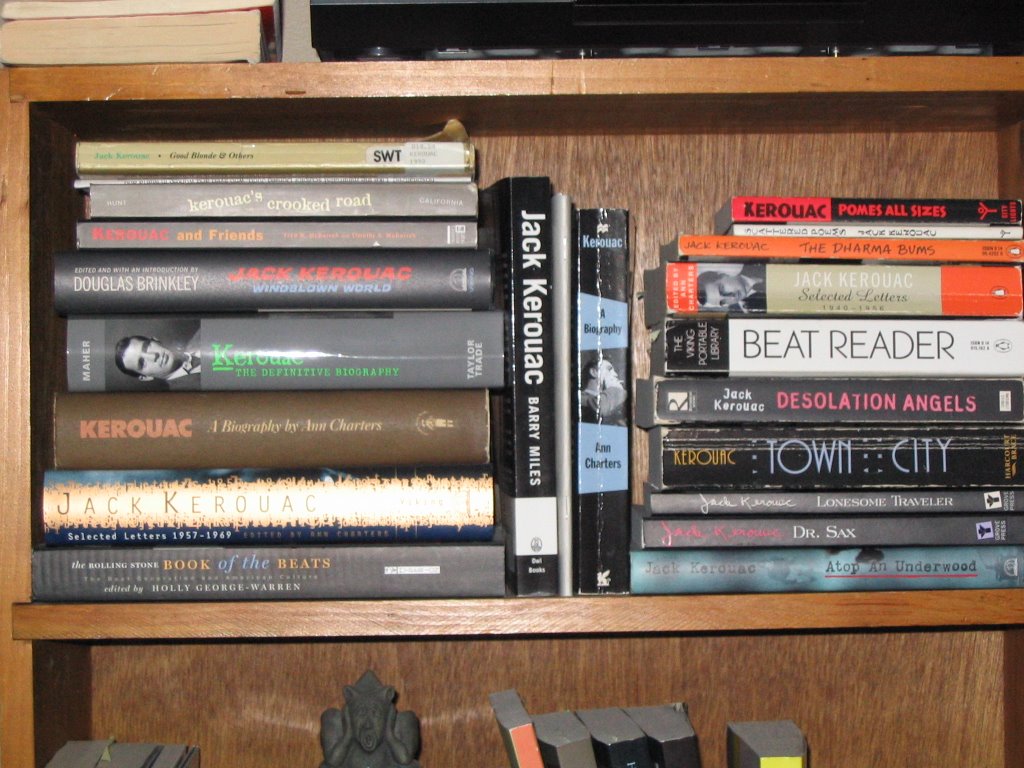
Some Jack

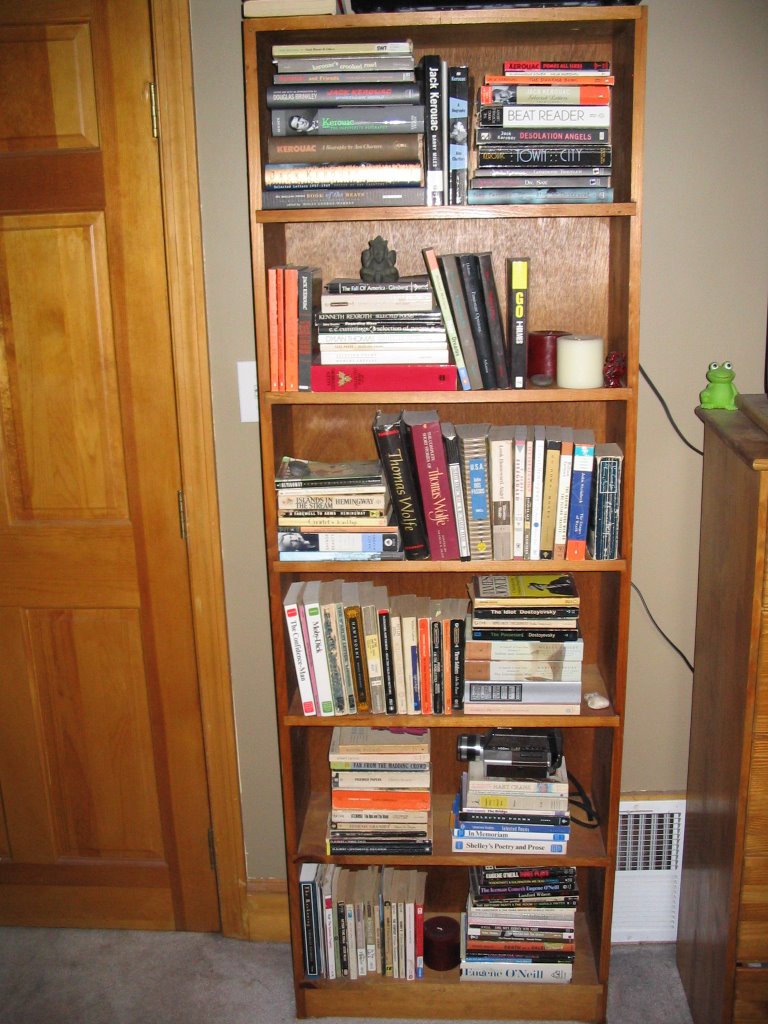
My books and a plastic frog


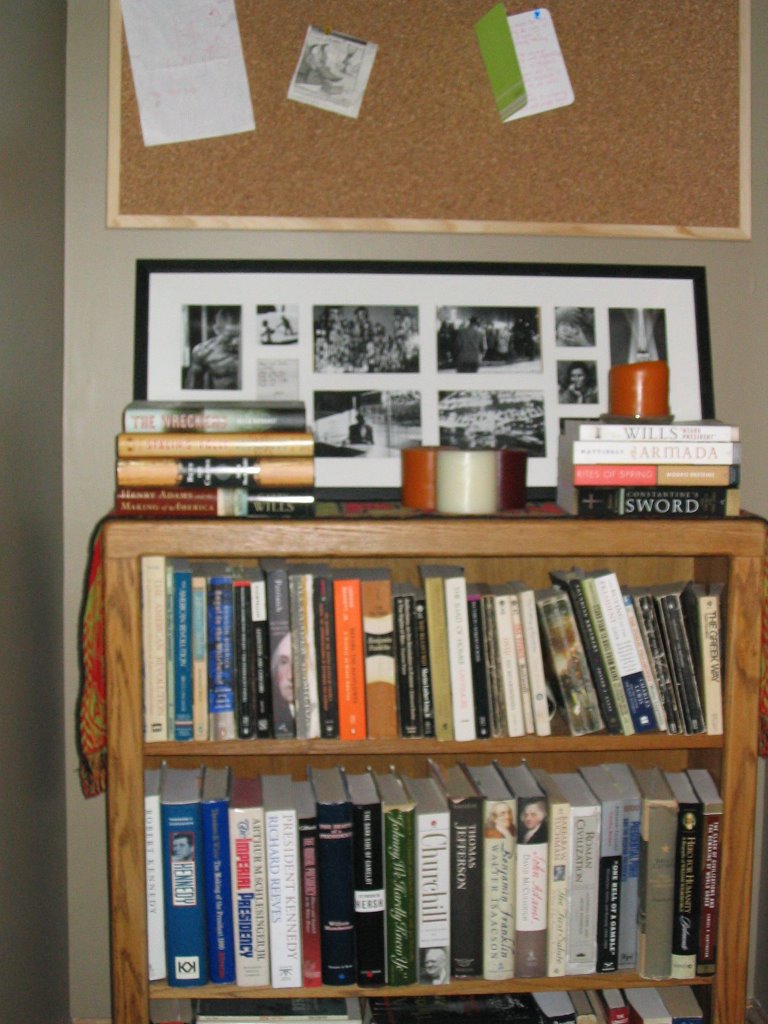
History and politics


Where I blog and write (and daydream)


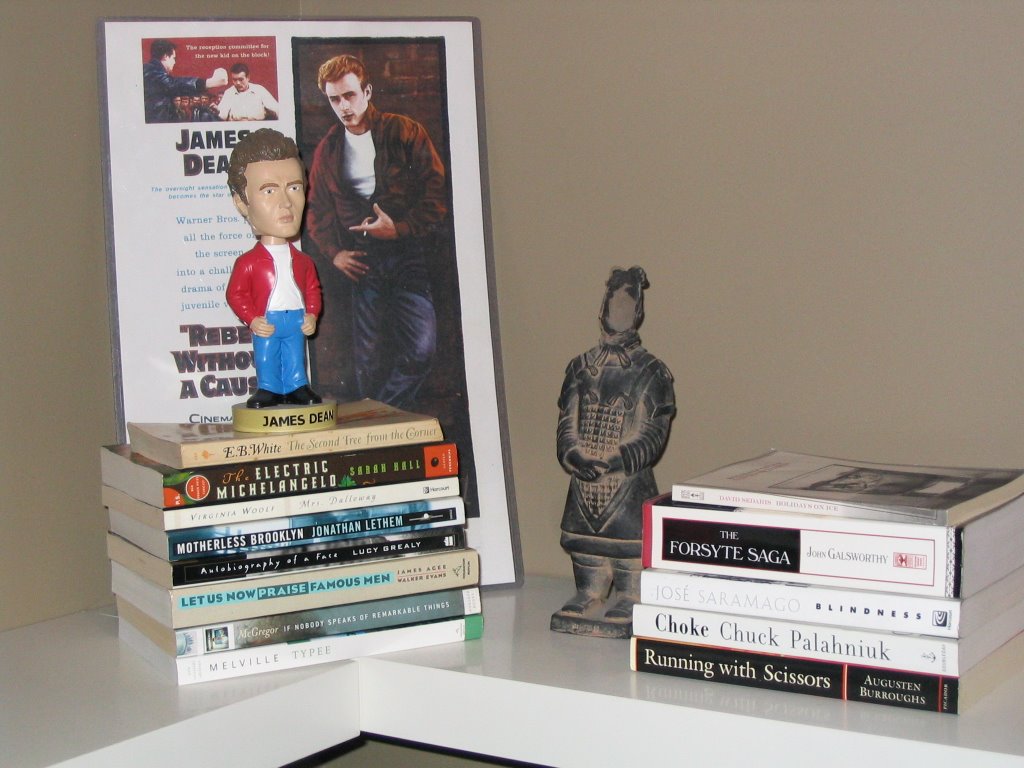
Yes, that's a James Dean bobblehead

There are times (often) when I wish I was a better writer. After reading Mitchell's Cloud Atlas, I wish I could write better if to only write a decent review of this genius novel. Five narrators transcend time, space and the page, leading the reader through a maze of dialogue, characters and intrigue. The sixth part has yet another narrator with an odd Irish brogue-like diction that somehow makes the preceding chapter and thus, all the other chapters, make sense. Then, Mitchell deftly takes us back to the other narrators in descending order tying up loose ends along the way. More often than not, Mitchell neatly depicted the fine way each narration and story line was intricately linked to the prior one, as well as to the next. What may appear to be six separate sections of a novel are six distinct voices, each telling their story directly to the reader, making an immensely universal story, personal. And to me the hallmark of a great writer is being able to make the specific universal and the universal specific.

I could possibly have more to say on this book, but I have to think about it a little more before I try my hand at explaining it. I think better at night, when the quiet of night is broken only by my laborious typing and Coltrane's guidance.

Currently reading:
Kate Atkinson Case Histories

Just bought/on deck:
Cynthia Ozick Heir to the Glimmering World
Barbara Croft Moon's Crossing
Robert Stone Outerbridge Reach

Wednesday, March 22, 2006

"We don't receive wisdom; we must discover it for ourselves after a journey that no one can take for us or spare us."
Marcel Proust

I was a pretty good student, but loved school so much that I was a full-time student until I was 26 years old. Yet, I believe that I learned most outside the school walls, outside the confines of curriculum. I was never taught Proust, Herodotus, Plutarch. I was never taught Maeve Brennan or E.B. White. No one took time to teach the origins of the Beat Generation. Instead, my education, my informal education came from libraries and used book stores. My education took place after school hours. At night under a reading lamp that cast shadows more than it illuminated, I read about the Battle of Thermopylae and the Hamilton Burr duel; I read Flannery O'Connor and Gary Snyder while my friends talked on the phone or went to the mall. I read Hemingway, Wolfe and F. Scott. Without knowing why, I read Henry Miller and Ezra Pound who I didn't understand. Pound still confuses me. I don't know what all this means or what it's supposed to mean. I do know that I found myself in these books, in other people's words, in other people's lives. I found my voice in their language. I found my way by following them down side streets in Paris, in the Gothic South and along the California coast.

Finished:
David Mitchell Cloud Atlas

Currently reading:
Kate Atkinson Case Histories

Monday, March 20, 2006

I should have started reading contemporary writers awhile ago. My attempt to read current books is a new phenomena. I can only imagine what I've missed during my odd snob period. I'm still a book snob, but now I'm at least attempting to read newer books, though I still find it difficult to buy a new hardcover book for $30 when I can buy two paperbacks for the same price.

David Mitchell is such a writer that I would have passed over and read a supposed classic in his place. Since he's compared to Pynchon, I may have read The Crying of Lot 49 or Gravity's Rainbow. Both classic novels in their own right, but I would have missed the genius of Mitchell. Each chapter of Mitchell's Cloud Atlas changes narrator, but has the perfect continuity of a novel. Each chapter, though completely different in form, is linked, touched, to the previous section and the reader passes through nineteenth century New Zealand, 1970s California, some futuristic Asian setting and I can only imagine what's to come in the second half of the book.

...

Today in Boston, the wind is shooting chills through our layers of clothes and tingles our spines. The beginning of spring taunts those of us that brave the below normal cold. Carrying my book to work today, I thought my hand would freeze to the binding, but I didn't think this would be a problem. Having your hand forever on a book, bliss? The book didn't freeze, my hand and mind heated up, slowly for sure, and today we long for the spring to come. Not tomorrow, but to come.

Now reading:
David Mitchell Cloud Atlas

On deck:
Kate Atkinson Case Histories

Friday, March 17, 2006

Yesterday was pay day and with the money in my account, without missing a beat, I fell off the wagon. My two week hiatus from purchasing books, new or old, was over by 1:15 p.m. Normally I walk up Newbury Street to the Trident bookstore, but yesterday I wanted to, needed to, buy some books asap. Thank you MBTA. Hopped on the Greenline and two stops later I was in the store. I could have bought four hardcover sale books for less than the price I paid for my two paperbacks, but I wasn't in the mood to lug four hardcovers around. (Hardcovers could have been
Adventures of Augie March
by Bellow, two Banville novels and something else.)

I bought David Mitchell's Cloud Atlas and Kate Atkinson's Case Histories. A little behind in the game, I know, but I've been wanting to buy them for awhile. But first I wanted to go through some books that I had laying around at home. If I didn't read Plot and Extremely Loud when I did, I may never have.

I may only be 50 pages in to Cloud Atlas, but my man can write. I didn't necessarily love the first chapter, but I liked how it was written. It seemed like an attempt to make a Melvillian entry. The second chapter is great so far. A struggling musician throwing himself at the door of his idol should be revealing. (I guess if Kerouac were still around, I'd have been at his door.)


Though I wanted to finish Cloud Atlas this weekend, I probably won't. There are pubs to go to today right after work, then my second job tomorrow, leaving only Sunday.

It's cool outside, but the smell of spring is in the air. The sidewalks are strewn with peoples in green today, the day everyone's Irish.


And thanks to Bookdwarf, we have the heads up that David Mitchell will be at the Harvard Bookstore April 19.

Wednesday, March 15, 2006


I didn't hate it. Not a glowing endorsement, I know. Philip Roth's Plot Against America was better than I was led to believe, but not as good as I hoped. If that makes any sense. A friend of mine read it. Well, she read most of it, but stopped with about 30 pages left. That's not a good sign. And still, I chose to read it. The first 100 pages are pretty good. In a weird way it reads like a non-comical version of Woody Allen's Radio Days. Depictions of 1930s and 1940s New Jersey interlaced with history. Franklin Roosevelt, Charles Lindbergh, La Guardia, Hitler, Walter Winchell and other historical figures play important roles throughout the novel.

After the first 100 pages, Roth loses me. Though the idea of Lindbergh winning the 1940 presidential election and signing a treaty with Hitler is intriguing and horrifying, Roth's language bores me. It's tiresome to read the middle part. It's too history bookish and not literary enough for me.

The anti-semitism that begins to ruin America is astonishing and still, all to real. And even though you know the story is false, it reads like the truth. That seems to be Roth's point throughout the novel...figuring out what the Truth is. Is Lindbergh trying to wipe out Jewish Americans like his counterpart in Germany? Or is Roth's family and their friends taking it all wrong?

I like how Roth shows how easy it would be for our greatest fears to become realized. That what we hold dear and sacred could become our grave undoing. Though I felt it was a struggle to read, I know that not all good things come easily.

Would I recommend Plot? Yeah. Though it may be a bit tedious, I think I gained something from reading it. And that's all I can ask.

Currently reading:
Dashiell Hammett The Thin Man

On deck:
David Mitchell Cloud Atlas

Tuesday, March 14, 2006

Death be not proud When you lose a loved one...an iPod that is.

Reading and old article by Jonathan Coe in The Guardian on Billy Wilder

"The verbal dexterity of Wilder's screenwriting seems to imply, for some critics, that there must be some corresponding visual paucity. They seem unable to acknowledge that the films are both visually and verbally rich, which is surely what must be asked of an art form that has had the capacity to combine both sound and vision for all but the first few years of its history. Wilder began his career as a writer - a journalist, in fact - working in Vienna, the city of his birth, where he wrote profiles of celebrated contemporaries including Freud. (The main thing he remembered from his visit to Freud's consulting rooms was that the famous couch was much smaller than he expected. Later in life, this caused him to dismiss Freud with the observation that "all his theories were based on the analysis of short people".) His early journalism has recently been anthologised and published in Germany, although it remains untranslated."

Thanks to Bookish for the link.

Sunday, March 12, 2006

I haven't read 10 pages of anything, other than the new Entertainment Weekly, since Friday. I feel...strange.

"I was leaning against the bar in a speakeasy on Fifty-second Street, waiting for Nora to finish her Christmas shopping, when a girl got up from a table where she had been sitting with three other people and came over to me. She was small and blonde, and whether you looked at her face or at her body in powder-blue sports clothes the result was satisfactory." - first paragraph of Hammett's The Thin Man

Friday, March 10, 2006


Saying I was hesitant to read Jonathan Safran Foer's Extremely Loud and Incredible Close would be kind. I was dreading it. I work in publishing at Houghton Mifflin, which publishes Foer and I got the book for free. But I couldn't stand his Everything is Illuminated. Like an albatross circling over head, I knew I needed to read Extremely Loud if I wanted to swear off Foer forever. Good thing I did. I wouldn't say he won me over, but I really enjoyed the novel. Foer certainly grew as a writer and storyteller with his second book. He got a lot of attention early on with his debut novel, but there was no sophomore slump. With a keen ability to write about the loss of a loved one, Foer made his narrator, 8 year old Oskar Schnell, a well rounded, odd, guide.

Showing signs of autism (as a fellow reader noted,) Oskar, wearing all white, all the time, finds a key that he thinks belonged to his father who was killed on 9/11. The rest of the novel follows Oskar as he tracks down all the people in the New York City area with the last name of Black. In his travels to Queens and Brooklyn, Oskar wants to find the lock to match the key so he can find some answer. Like many child narrators, Oskar is often too insightful, too cynical and too smart for his own good. Still, Foer doesn't let Oskar's countless quirks weigh the story down. Instead, in Oskar, we have a young boy, trying to deal with the murder of a loved one the only way he knows how.

Now reading:
Philip Roth The Plot Against America

On deck:
Dashiell Hammett The Thin Man

Next purchase:
David MitchellCloud Atlas

Listening to:
Deathcab for Cutie Crooked Teeth
For a fascinating look into the art and creativity involved in publishing a book, read William Gass's instructions for publishing his novel The Tunnel

Tuesday, March 07, 2006

Testing out the new google blogger widget 
I should finish Extremely Loud today. Has Mr. Foer won me over?


On deck:
Philip Roth Plot Against America

Listening to:
Last week's Prairie Home Companion

Monday, March 06, 2006

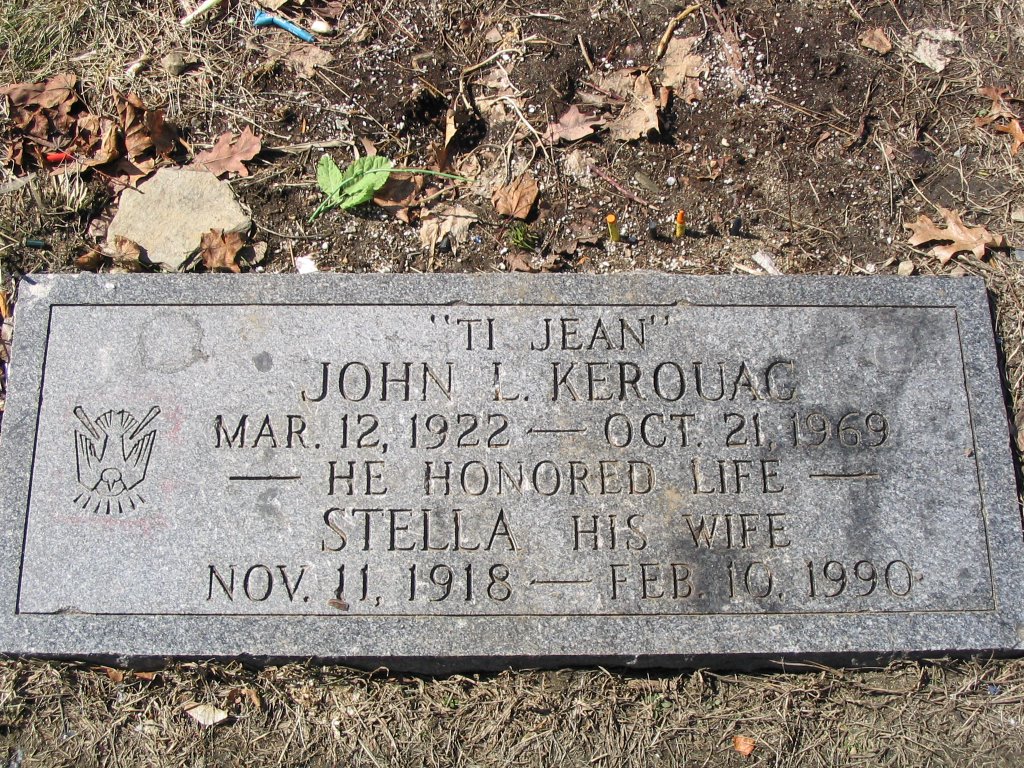
Kerouac's grave in Lowell
Ti Jean's birthday is less than one week away
Started reading Jonathan Safran Foer's Extremely Loud and Incredibly Close and fear that my disdain for his first novel has carried over. His first novel was like a comedy skit that went on too long. And though I'm only 40 pages in to Extremely Loud, it seems like he was continued to beat the dead horse. I can see why people may think he's creative and that his storytelling is unique, but I think it's tedious. He takes the easy way out.

Friday, March 03, 2006

Yesterday, one of my friends, a fellow blogger, asked me if I was ever going to post something on a topic other than books. Since I'm trying to keep this a book blog, I told her no. Though I often get the urge to write postings about politics, sports, work and other generalities of my life, I have refused to do so. Until now it seems. But I'll let it end here. I know a lot of bloggers out there, and I'm still a neophyte, who want to become the next Julie Powell (author of Julie and Julia : 365 Days, 524 Recipes, 1 Tiny Apartment ) and have their blogs discovered and be asked to write a book. But this is a dream akin to one I had growing up and wanting to be a space cowboy. It isn't going to happen. And we know this. Still, we stay up late writing our blogs that only our friends read when they're bored at work. We still wake up early to send out an e-mail letting our family know we posted again. While cooking dinner we try to remember that quote from some book so we can post it and sound witty. Pseudo-intellectual am I. And for no other reason than biblio-vanity, I will post again. And again. For that I'm not sorry

On the recommendation of a friend, I read Julia Glass's novel, Three Junes. It's a departure from what I normally read, but it was an enjoyable and quick read. It's told in three parts, by three different narrators.

The first section of the book, which was originally published as a novella, was narrated by newly widowed Paul McLeod. A newspaper publisher from Scotland, Paul is traveling through Greece on a tour. Along the way he forms a strange bond with an energetic woman who acts like a den mother and he finds himself attracted to a much younger American art student, Fern. However, Fern's attentions are drawn to the travel guide, John. The most memorable part of Paul's passage, was when one of the woman mentioned that he wasn't buying any souvenirs or taking any pictures. Paul said he took the trip to lose memories, let them go, not make new ones.

Paul's oldest son Fenno narrates the second section of the novel. Fenno, who is gay, guides us through the deaths of his mother and more recently his father. A bookstore owner and caretaker for a friend dying of AIDS, Fenno journeys back and forth from Scotland to New York; from artist lover to deathly ill friend; from pedigree dogs to parrots. Glass's description of the epidemic of AIDS was well constructed, showing the reader the demise of a once active man's body. Fenno's friend, Malachy "Mal" Burns, may be Glass's strongest character. His dry wit and biting observations, make the dying music critic a strong focal point to Fenno's sometimes undefined life. Mal's seeming courage in the face of death has just enough sentimentality to sustain the emotion.

In the third sections, Glass returns to Fern to lead us home. Fern is now in her mid thirties, also a widow and now pregnant with her new boyfriend's baby. The entire episode takes place in a summer house, in which her friend Tony is house sitting. Drawing the story together, Tony is Fenno's former lover and house sitting for Fenno's friend and business partner. When Fenno shows up at the house unexpectedly, he and Fern are drawn to each other, building and an immediate relationship. Fern even says that if it were ten years ago, she would have fallen in love with him. But perhaps she still has. Perhaps this is the friendship we all look for, but seldom find.

Glass manages to intertwine the lives of numerous, mostly fully realized characters. And though the story itself centers on predictable themes of love, death, birth and hope, Glass is able to make them her own. And because of that, we are grateful readers.

Now reading:
David Liss A Conspiracy of Paper

Listening to:
Travis Invisible Circus

Thursday, March 02, 2006

My new favorite book blogs are... Bookdwarf, Tingle Alley, Fresh Eyes and Pages Turned. Please check these out, they will be worth your while.

Bookdwarf is a bookseller in Cambridge who has all the info you'll need on Boston based book events, such as author readings. She's also posts her 'current reads' frequently. And unlike me, she's reading books that are either on the cusp of being published or on the verge of becoming noticed. In other words, she's on the frontline of books.

Tingle Alley is a wickedly smart reader in North Carolina. As far as book blogs go, hers is in depth.

Fresh Eyes is a now retired master bookseller from Vermont. His experience selling books, reading books and talking about books, make his blogs one of the best. He's also a great writer. Reading his blog makes me want to be a bookseller.

And Pages Turned is a blog I just started reading and now I'm reading the archives. A great blog to read while I act busy at work.

I just wish all these writers posted every day. Every hour of every day.

Oh yeah, and check out my friend (non-book blog) Blogalicious

Wednesday, March 01, 2006

The Associated Press has reported that the New York Public Library has bought the official collection of the William S. Burroughs archive. Now, Burroughs's letters, correspondence and notes will be within the same walls as Kerouac's. However, Ginsberg's archive is 3,000 miles across the country at Stanford.

Thursday, February 23, 2006


Jose Saramago is, if anything, an innovative story teller. Page after page, his novels unfold in surrealist scenes and schemes. His characters do things that many of us wish we did, wish we could do. In The History of the Siege of Lisbon, a gifted proofreader decides to place a Not in a history book, where a Yes was supposed to go. In the 12th Century the Portuguese king asked the Catholic Crusaders to help Portugal fight the Moors in an effort to regain Portugal. The Crusaders said Yes. Raimundo changed this Yes to Not. In essence, the proofreader was rewriting history. Something I have wished I could do. While Raimundo Silva waits for the editors to find the mistake, if they find the mistake, he's anxious, but not nervous; he's cautious, but not ashamed. He goes to the office more than usual, as like he says, a criminal revisiting the scene of the crime (I'm paraphrasing.) But it's not the scene of the crime, because Raimundo works from home, like writers do. He stays up late pouring over manuscripts, like writers do. And that's how the book turns. Raimundo's intentional infraction is found, but he isn't fired. The publisher values his proofreading skills too much. However, they have hired a head proofreader who will have final say on manuscripts. It's a woman and she changes Raimundo's life. She gives him the only copy of the history text that wasn't revised. Or more accurately the only copy that didn't have a "erratum." So, in fact, he has rewritten history, even if he, the author and the editors, especially Dr. Maria Sara are the only ones that know. Dr. Maria Sara then asks Raimundo to actually write his own book on the Siege of Lisbon as if the Crusaders actually didn't help the Portuguese. After saying no to her initial suggestion, Raimundo has reconsidered and has begun his book. He has yet to tell Dr. Maria Sara.

Reading Saramago is an experience for the narrative in itself. No quotation marks. No traditional paragraphs. No traditional conversations/dialogue. It's amazing that your mind is able to catch on so quickly the this change in form.

Tuesday, February 21, 2006


Have I ever told you how much I love reading E.B. White? There's great humanity in his writing. Through his writing, he has become the grandfather I wished I had. He is the type of man of letters that I dare to become. He writes adoringly and critically of the overwhelming city where anything is possible. He writes of the country and his animals, our animals, us. This man who wrote Charlotte's Web, who for years I thought was only a children's author, was a poet, an editor, a grammarian, a farmer, a husband, a father, a letter writer and part of the most significant literary partnership with his wife and noted editor of the New Yorker, Katherine. E.B. White, Andy as he was known to his friends is widely overlooked in academics and to a large degree in general literary discussions. Let this not be the case any longer.

Books I've purchased:
David Liss A Conspiracy of PaperBalzac A Harlot High and Low
The complete novels of Dashiell Hammett
E.B. White The Second Tree from the Corner
Jose Saramago The History of the Siege of Lisbon
(all bought used for a total of $7.72)

Books I've read:
E.B. White The Second Tree from the Corner

What I'm reading:
Saramago The History of the Siege of Lison
Ocshner People I've Wanted to Be

On deck:
Liss A Conspiracy of Paper
Julia Glass Three Junes

What I'm listening to:
Art Tatum On the Sunny Side of the Street

Friday, February 17, 2006


I literally couldn't put Sarah Hall's second novel, The Electric Michelangelo down. It's cliche, I know, but it's true. In two quick days, I read fascinating novel of Cyril (Cy) Parks, a gifted tattoo artist from Northern England that learns his art from one of England's most enigmatic characters, Eliot Riley. Cy, begins his apprenticeship with Riley during the inter-war period of the 1920s. Riley, a drunk, but brilliant tattoo artist, teaches the fairly naive Cy, about art, tattoos, life and love. Well, actually not so much love as much as sex. When Riley dies, Cy packs up and moves to New York and is taken in by former carnival workers and ushered into the world of Coney Island where anything goes. It's here that Cy meets a mysterious woman who keeps a horse in her small apartment and has Cy cover her body in a single tattoo, over and over again. But more than the larger than life characters, it's Hall's language that moves the story on, making the reader never want it to stop, like a ride on a Coney Island merry-go-round.

"The tide was a long way out, further than he could see, so far as
anyone knew it was just gone for good and had left the town permanently
inland. It took a lot of trust to believe the water would ever come
back each day, all that distance, it seemed like an awful amount of
labour for no good reason."


The only thing I can compare this novel to is Moby Dick. Maybe it is a modern take on Moby Dick. Both novels focus on characters that explore themselves and observe the underbelly of human nature. And by no small feat, Hall is able to create an astounding work of fiction that may one day be able to be seriously considered an equal to Moby Dick.

Currently reading:
Gina Ochsner People I Wanted To Be

On deck:
TBA

Listening to:
Clifford Brown and Max Roach

Tuesday, February 14, 2006


I'll give Lethem credit for attempting to play with narrative form in The Fortress of Solitude. However, with such a large novel concerning the same protagonist, Dylan Ebdus, his switch from third person narrator to first person was abrupt. The tone of the novel changed considering the different way the narrator viewed the story. However, the language of the novel also changed, but not significantly. And maybe that's my problem with the narrative arc. Why didn't Dylan tell the story the entire time? Did Lethem think Dylan was too young to carry the story from his viewpoint? Did Lethem write two books at once? One about the younger Dylan and one about the older Dylan? One of the reasons I love literature is that it's the reader's interpretation. No one else's. I know other readers will have a different take on the split novel. I enjoyed it. I highly recommend it. Lethem hasn't disappointed me yet. Though he's older than me, I feel some kinship to him, to his characters and too his New York. That's what makes him a gifted writer. That's why I'll read his next novel. And his next. And his next. Literature is supposed to make us think. It's supposed to sound like the beats of life. It's supposed to move us. At least that's what it does for me and none seem to do it as well as Jonathan Lethem.

Just finished:
Kazuo Ishiguro Never Let Me Go

Now reading:
Sarah Hall Electric Michelangelo

On deck:
Gina Ochsner People I Wanted To Be
Books to buy:
Elizabeth Crane's "When the Messenger is Hot"

Thursday, February 09, 2006

I haven't bought a new, full priced hardcover book in awhile, but I think I may make the move. The excerpts I've read of Sara Gran's noir novel Dope, were great. Yes, they seem to have been written by Raymond Chandler himself, but the language is all her own. I haven't read enough to make a realistic opinion, but I've read enough to know I want to read it immediately.

I'm almost finished with Lethem's Fortress of Solitude and will write more on it once I'm done. Though it's a great book, indicative of a time, a place and a culture, it doesn't have the same weight as Motherless Brooklyn. The prose reads the same way and the reader can still feel and smell the city streets Lethem describes, but the purpose of the book shifts. Through the first half I thought it was going one place and ended up going another. This may have been Lethem's purpose, I don't know. And at times the narrator doesn't let the reader in to certain aspects of the main character's life that I thought were significant. i.e. How he felt about his mother abandoning him, how he felt toward his artist father, etc.

But more on this in a few days when I've gathered my thoughts.

Now reading:
Jonathan Lethem Fortress of Solitude

On deck:
Kazuo Ishiguro Never Let Me Go
Gina Ochsner People I Wanted to Be

Tuesday, February 07, 2006


Late last year I read the novel Disgrace by J.M. Coetzee." It was one of the most visceral reading experiences I've had. My body ached as I read it. The prose was perfectly sparse. In fact, it was gorgeously written. I had wanted to read the book for years, but never did. Now I just finished Elizabeth Costello. For two days I was mesmerized by his ability to play with narrative forms. In the first chapter, titled Realism, he, the narrator, skips to parts of the story that only carry the novel forward. Of course that's what a good narrator does, but Coetzee has the narrator actually tell the reader, "I'm skipping ahead because nothing really happens here." I paraphrase, but it was surreal. The book itself follows the title charcter, Elizabeth Costello, as she accepts an award in Atlanta, gives speeches aboard cruises and takes part in a series of lectures. There are definitely writers, women especially, but possibly even men, that write in a woman's voice better than Coetzee. But no man that I've read has written such a strong female character. Forceful, unforgiving, brilliant, sexual. To me, she was everything women like Isabel Archer are not. Elizabeth Costello was everything I look for in full-bodied literary figures. She won't leave the reader's head for awhile if ever.


p.s.
Coetzee reportedly once went to a party and didn't say a singe word all night. I'm glad he saves his best words for his novels.

Now reading:
Jonathan Lethem's Fortress of Solitude
Shelby Foote's Civil War

On deck:
Kazuo Ishiguro's Never Let Me Go
Gina Ochsner's People I Wanted to Be

Listening to:
Rilo Kiley's We'll Never Sleep (God Knows We'll Try)

Thursday, February 02, 2006


Sometimes I pick up a book or start reading a book solely because it has won an award. I know that the saturation of awards has made most awards worthless, but I still find myself looking to them. Once again I've been let down. Lily Tuck's The News From Paraguay won the National Book Award, but shouldn't have. It's a choppy book, full of jutting paragraphs, short chapters, underdeveloped characters and a so-called protagonist that Tuck failed to give structure to. How this novel won the NBA is beyond me. My friend and I were recently talking about the poor writing of our peers in grad school. How the writing was embarrassing to read. Sort of like this blog. Well, Tuck's novel was like that. It was as if a grad student's manuscript somehow got through the editors at Perennial and was published by gross neglect.
When reading a book I have to 'like' the main character. I don't know how else to describe it. I don't want to sympathize, empathize, or love the character; just like. Tuck's Ella Lynch is such an underdeveloped character that it makes the novel seem like whole parts were edited out and the structure was never reshaped. Why would I care to keep reading about an Irish woman that falls for an arrogant man while living in Paris, becomes pregnant, moves to Paraguay with him, he becomes dictator, have more of his children, never marry him, allow him to keep lovers, cheers him on as he starts war with three countries and devastates his home country? Maybe it's just me.

Now reading:
J.M. Coetzee's Elizabeth Costello
volume I of Shelby Foote's Civil War

Listening to:
Feist

p.s.
Oh yeah, I should mention, my sister graduated college last Friday!! She's "growns up, is growns up"

Tuesday, January 24, 2006

I used to read only one book at a time. Not anymore. I usually have one book that I try to read at all times, presently Shelby Foote's Civil War, but I always have others around the house, within reach. Tobias Wolff's Old School, A.B. Guthrie, Jr.'s The Big Sky and Lily Tuck's The News From Paraguay on my desk, next to my laptop, where the shadow from my desk lamp covers a quarter of the books, while casting a larger shadow over the Marc Chagall postcard that I'm no longer using as a bookmark.
On my bedside table, I have Philip Roth's The Plot Against America dominating my tiny black alarm clock, but fighting for space with the steel reading lamp. On the bottom shelf the night stand is Thoreau's Walden and Henry James's The Portrait of a Lady, which I've discarded for the time being. On the opposite side of my bed, on my unfinished wood crate filled with my vinyl, are the other two volumes of Foote's Civil War and Jonathan Safran Foer's Extremely Loud and Incredibly Close, which I'm hesitant to read because I disliked Everything is Illuminated so much. (Even though I wanted to like it so much. But I loved his wife, Nicole Krauss's, novel The History of Love. Possibly one of the best books I read last year.)
I've never read anything by Roth before, so I'll probably start Plot soon enough, but I don't really know which book I'm going to begin next. I just like to keep my options open.

Thursday, January 19, 2006


Shelby Foote's narrative history of the Civil War is brilliant...thus far. I'm only 250 pages in to the three volume, 3,000 page saga, but it reads like an epic novel. Asked to write a book on the Civil War, the Southern born writer began, but couldn't stop. Over 3,000 pages and decades later, Foote's three volume narrative stands as a testament of American literature and history. Foote's account is unique in it's ability to transcend traditional history writing standards. Like his contemporary David McCullough, these two men are writers who chose American history as their subjects. Though Foote wrote numerous novels that met with some success, it was his Civil War that made him a respected literary figure and historian.
But it wasn't until Foote was featured in Ken Burns's Civil War documentary, in which Foote was the main commentator, that he became a star. His smooth Southern accent, wit and storytelling made him a sensation. The white-bearded Foote's novel found a new audience. And it's the first time I heard of him. I was as much amazed with the engaging Foote as I was with the documentary as a whole. But it wasn't until this week that I started the first volume. If anyone has any qualms about reading books on history, should pick up this volume...or at least the first book. There are no footnotes, no endnotes, just a story that is all too real. We know many of the names, but through Foote, we begin to know the real men. I know it's a cliche, but it's true. Grant, Sherman, McClellan, Davis, Lincoln, Stonewall Jackson...I've only just begun the epic and may not finish all three volumes anytime soon, but I know I'm already a better person for reading this book. Shelby Foote, a great American author and an even greater man.

In memory of Shelby Dade Foote November 17, 1916 - June 27, 2005