Cross-posted at Slaves of Golconda
I was talking to my father the other day about invention. From the beginning of history, people conducted their lives in similar ways. For thousands of years, news traveled the same way, wars were fought the same way, food was cooked the same way. Then in the mid-1800s, the world changed. People went to sleep one dreamfilled night in what could have been 1625 and awoke to a world that they didn't recognize. Trains, the telegraph and later indoor electricity. The Victorians were on the doorstep of the modern world. They were the first through the door. And the advent of modern science was the umbrella that covered their contemporary lives.
Yes, Darwin changed the way people thought of humans and therefore thought of themselves. His studies allowed for people to begin experiencing life like never before. Dimensions to worlds unknown opened up. Seances and spiritualism became common. Victorians were expanding their spiritual and religious realm. If what they thought about themselves had been altered by science, then maybe what they thought or knew of the dead and the soul, was different as well.
But it was writers like H.G. Wells, that uncovered hidden truths in them all. Writers like Wells made readers and the public rethink what it was to be human. Not just how they thought, but how the felt. The emotional turmoil pervading society had to be a sort of shell shock. If humans came from apes, then what does that do to our sense of who we think we are? Do we feel like humans? What does that even mean? Or could we be nothing more than wild creatures that wear clothing? What truly distinguishes us from 'them.'
Reading The Island of Dr. Moreau, these were the questions I was dealing with, repeatedly returning to. Rationalization is not the only thing that seperates us. Neither is knowledge or conscience. It must be all.
The narrator of Moreau, Prendick writes, Yet I felt an absolute assurance in my own mind that the Hyena-Swine was implicated in the rabbit-killing. A strange persuasion came upon me that, save for the grossness of the line, the grotesqueness of the forms, I had there before me the whole balance of human life in miniature, the whole interplay of instinct, reason, and fate in its simplest form.
These animal-human hybrids are humans in Prendick's estimation. Their ability to reason has changed them and has made them all too human like. However, I wonder if it was their strange mutation into human like beings that gave them reason or if they had always had reason and were now only able to communicate it. I fall into believing the latter in this case. Moreau had partly succeeded in his dungeon of science.
Prendick's experience on the lost island of mutation and vivisection, changed his way of feeling. It certainly changed the way he thought and what he thought about. Everything he thought he knew before, was turned upside down. He was left grasping.
I fell indeed into a morbid state, deep and enduring, alien to fear, which has left permanent scars upon my mind. I must confess I lost faith in the sanity of the world when I saw it suffering the painful disorder of this island.
A blind fate, a vast pitiless mechanism, seemed to cut and shape the fabric of existence, and I, Moreau (by his passion for research), Montgomery (by his passion for drink), the Beast People, with their instincts and mental restrictions, were torn and crushed, ruthlessly, inevitably, amid the infinite complexity of its incessant wheels. But this condition did not come all at once...I think indeed that I anticipate a little in speaking of it now.
This sentiment still reverberates today. I hear it echoed in Ginsberg's infamous first lines of Howl: I saw the best minds of my generation destroyed by madness, starving hysterical naked, dragging themselves through the negro streets at dawn looking for an angry fix. There's something primitive in Ginsberg's feeling of desolation and I sense the same in Prendick's lament.
As a society, we cope with watershed changes in a myriad of ways, but we have to deal with them nonetheless. But what does it mean to feel this way? Can we always change things for the better? Should we leave life, science, nature, better left untouched? I don't know.
I leave Dr. Moreau with more questions than answers...but I prefer literature that way. It is the discoveries I make on my own that validate my experiences.
Thursday, August 31, 2006


Wednesday, August 30, 2006
When I decided to give up on writing for a living (thank you Emerson College and your Master's Degree in Print Journalism!) the world opened up to me and didn't close in and suffocate me like I envisioned. Everyday was a battle, questioning myself, questioning my writing. My writing didn't match up to my peers in grad school, let alone the rest of the literary world. The outlook was bleak. My decision had nothing to do with giving up. If anything, it was overcoming a frightening obstacle. I am now able to pursue careers in nearly any field, experiencing places and people without having to sit and write for an editor. I write for myself and that's all I really ever wanted. I'm not Pepys and I don't intend to imitate any such personal journalists, diarists, essayists or even modern bloggers. I've written about this before, but the past few days have been trying, stretching my will to points unknown.
"All writers read, but not all readers write." I don't know exactly who said that and it doesn't particularly matter. In fact, I'm repeating myself, because I know I've written a piece on this before. But the point is, I read. I'm not a critic or reviewer. I'm not articulate enough. I'm a reader. It's what give me breath each morning and keeps me awake at night, listening to the creaking of the window panes. It is what I've become.
Last night, I continued reading Allen Ginsberg's journals from the 1950s. It is this experience that has reinforced my decision. I could never compare to genius. He was about 30 years-old when he started these journals in 1954 and his mind grasped words, concepts, structure and history as well as anyone. I'll be 30 in three years, by then, maybe I'll be able to understand half of what I read. Ginsberg knew he was to be a 20th Century Whitman. It was his destiny to write of a life, his life. It was his salvation. My salvation comes in a form of voyeurism, where I get to sneak into his bedroom late at night and steal through his journal. My salvation is in this reading. My nirvana comes with the crafted printed word.
(For a related article, check out Emily Barton's review of Francine Prose's new book on writing in the NY Times.)
"All writers read, but not all readers write." I don't know exactly who said that and it doesn't particularly matter. In fact, I'm repeating myself, because I know I've written a piece on this before. But the point is, I read. I'm not a critic or reviewer. I'm not articulate enough. I'm a reader. It's what give me breath each morning and keeps me awake at night, listening to the creaking of the window panes. It is what I've become.
Last night, I continued reading Allen Ginsberg's journals from the 1950s. It is this experience that has reinforced my decision. I could never compare to genius. He was about 30 years-old when he started these journals in 1954 and his mind grasped words, concepts, structure and history as well as anyone. I'll be 30 in three years, by then, maybe I'll be able to understand half of what I read. Ginsberg knew he was to be a 20th Century Whitman. It was his destiny to write of a life, his life. It was his salvation. My salvation comes in a form of voyeurism, where I get to sneak into his bedroom late at night and steal through his journal. My salvation is in this reading. My nirvana comes with the crafted printed word.
(For a related article, check out Emily Barton's review of Francine Prose's new book on writing in the NY Times.)
Tuesday, August 29, 2006
I don't know why I haven't written in nearly a week. Probably just laziness. I've been reading Byatt's Possession and only have about 190 pages left. It's longer than I thought it was, but it's good. I'm not totally impressed with the language, but the story's fairly entertaining.
I've also been finishing The Island of Dr. Moreau. I'm still surprised how much I've enjoyed the book. I didn't finish my extra credit book, The Time Machine, but I Wells has been a more than pleasant surprise.
I've also been finishing The Island of Dr. Moreau. I'm still surprised how much I've enjoyed the book. I didn't finish my extra credit book, The Time Machine, but I Wells has been a more than pleasant surprise.
Tuesday, August 22, 2006
It was either last year or earlier this year that I first read Ward Just. Just is a former journalist and war correspondent. An Unfinished Season was a well written book, but it just didn't affect me. However, his latest novel (a Houghton Mifflin title)Forgetfulness reads like it was written by a man under intense pressure, using as few words possibly to convey a point or express something. Now I know why Just is heralded with such acclaim. Reading his prose is like taking part in a fight. Each line hits you harder and harder. By the end of the book, I already know I'm going to be KO'd.
She was trying to put her mind in another place altogether but was so far unsuccessful. She was unable to free herself of the forest. It seemed to her the very end of the known world so she conjured images of welcome aliens. For now she was in the hands of strangers, dubious men who did not belong here. So she spoke aloud, telling them to be careful, to take their time, not to be so rough. She was no longer young, as they could see. And she was injured and not herself. She thought to add, "Please."
Florette, a fifty-five year old French woman, married to an American and living in the shadow of the Pyrenees, has injured herself while taking a hike in the foothills of the mountains that lead to Spain and beyond. But the men taking her down the hill in a stretcher are strangers. Florette's pain comes in rushes and her mind wanders, but it's her desire for the mundane cigarette or to take a pee, that makes the situation too real. I can picture soldiers in Vietnam being mortally wounded, being husked back to awaiting choppers, but asking for a cigarette in their dying breaths. Here Just, reflects this intense and common urge onto the reader, making us all too aware that we would probably react the same way if the situation were reversed.
Now reading:
Ward Just Forgetfulness
H.G. Wells The Island of Dr. Moreau
H.G. Wells The Time Machine
Just finished:
Jack Kerouac Tristessa
Sarah Waters Fingersmith
She was trying to put her mind in another place altogether but was so far unsuccessful. She was unable to free herself of the forest. It seemed to her the very end of the known world so she conjured images of welcome aliens. For now she was in the hands of strangers, dubious men who did not belong here. So she spoke aloud, telling them to be careful, to take their time, not to be so rough. She was no longer young, as they could see. And she was injured and not herself. She thought to add, "Please."
Florette, a fifty-five year old French woman, married to an American and living in the shadow of the Pyrenees, has injured herself while taking a hike in the foothills of the mountains that lead to Spain and beyond. But the men taking her down the hill in a stretcher are strangers. Florette's pain comes in rushes and her mind wanders, but it's her desire for the mundane cigarette or to take a pee, that makes the situation too real. I can picture soldiers in Vietnam being mortally wounded, being husked back to awaiting choppers, but asking for a cigarette in their dying breaths. Here Just, reflects this intense and common urge onto the reader, making us all too aware that we would probably react the same way if the situation were reversed.
Now reading:
Ward Just Forgetfulness
H.G. Wells The Island of Dr. Moreau
H.G. Wells The Time Machine
Just finished:
Jack Kerouac Tristessa
Sarah Waters Fingersmith
Thursday, August 17, 2006
The start, I think I know too well. It is the first of my mistakes
I imagine a table, slick with blood. The blood is my mother's. There is too much of it. There is so much of it, I think it runs, like ink. I think, to save the boards beneath, the women have set down china bowls; and so the silence between my mother's cries are filled-drip drop! drip drop!-with what might be the staggered beating of clocks. Beyond the beat come other, fainter cries: the shrieks of lunatics, the shouts and scolds of nurses. For this is a madhouse. My mother is mad. The table has straps upon it to keep her from plunging to the floor; another strap separates her legs, so that I might emerge from between them. When I am born, the straps remain: the women fear she will tear me in two! They put me upon her bosom and my mouth finds out her breast. I suck, and the house falls silent about me. There is only, still, that falling blood-drip drop! drop drop!-the beat telling off the first few minutes of my life, the last of hers. For soon, the clocks run slow. My mother's bosom rises and falls, rises again; then sinks for ever.
I feel it, and suck harder. Then the women pluck me from her. And when I weep, they hit me.
- Sarah Waters Fingersmith
I imagine a table, slick with blood. The blood is my mother's. There is too much of it. There is so much of it, I think it runs, like ink. I think, to save the boards beneath, the women have set down china bowls; and so the silence between my mother's cries are filled-drip drop! drip drop!-with what might be the staggered beating of clocks. Beyond the beat come other, fainter cries: the shrieks of lunatics, the shouts and scolds of nurses. For this is a madhouse. My mother is mad. The table has straps upon it to keep her from plunging to the floor; another strap separates her legs, so that I might emerge from between them. When I am born, the straps remain: the women fear she will tear me in two! They put me upon her bosom and my mouth finds out her breast. I suck, and the house falls silent about me. There is only, still, that falling blood-drip drop! drop drop!-the beat telling off the first few minutes of my life, the last of hers. For soon, the clocks run slow. My mother's bosom rises and falls, rises again; then sinks for ever.
I feel it, and suck harder. Then the women pluck me from her. And when I weep, they hit me.
- Sarah Waters Fingersmith
Tuesday, August 15, 2006
It's getting darker earlier. With the 8 o'clock hour, comes the twilight. Only minutes later, the houses and trees whimper in the permanent shadows of night. Windows, lit from within act as beacons for the bugs repeatedly hitting the screens. They could be heard if all were quiet on the street. But it's never quiet. Not that quiet.
(But it's a perfect setting to read Sarah Water's Fingersmith)
(But it's a perfect setting to read Sarah Water's Fingersmith)
Monday, August 14, 2006
No one warned me. Hardy ends the last quarter of Jude the Obscure with such a devastating event, that I put the book down and just stared at it for a few moments. I won't give the details away and spoil the terribly sad plot. Once the catastrophe takes place, our heroine, Sue, becomes unhinged, taking to church and prayer daily, wanting nothing to do with poor Jude. The circumstances of their relationship are complicated to say the least, but Sue only compounds the situation at times. Sue was an individual and unique woman who wanted nothing to do of the traditional modes of life. She was not religious, but ended up changing her life based on repentence and religion. She was never keen on marriage, but ended up in loveless marriage, for the second time to the same man. This strong person was defeated by society and her own compulsive impulses, leaving Jude alone in the cruel world they once shared.
Yet, Hardy made Sue likeable past the point I would have thought. He didn't simply turn her over to make a point. He split up the two lovers, who were like one, to show how grief is assumed and love endured. Lincoln said a 'house divided can not stand' and I think that somehow fits this story. Together, Jude and Sue could withstand the taunts, jealousies and setbacks because they had one another. Seperated, they were destroyed souls, walking, but not living.
Just finished:
Thomas Hardy Jude the Obscure
Now reading:
H.G. Wells The Time Machine
Sarah Waters Fingersmith
On deck:
H.G. Wells The Island of Dr. Moreau
Yet, Hardy made Sue likeable past the point I would have thought. He didn't simply turn her over to make a point. He split up the two lovers, who were like one, to show how grief is assumed and love endured. Lincoln said a 'house divided can not stand' and I think that somehow fits this story. Together, Jude and Sue could withstand the taunts, jealousies and setbacks because they had one another. Seperated, they were destroyed souls, walking, but not living.
Just finished:
Thomas Hardy Jude the Obscure
Now reading:
H.G. Wells The Time Machine
Sarah Waters Fingersmith
On deck:
H.G. Wells The Island of Dr. Moreau
One meme, two meme, three meme...here's another via Litlove
1. First book to leave a lasting impression? Looking back, I guess William Saroyan's The Human Comedy has resonated with me through the years. Freshman year of high school, we had to read this and I never read anything like it before. It was the first 'real' thing I had read and Saroyan's language spoke to me and still does.
2. Which author would you most like to be? Before I thought about the questions, I figured I'd put Kerouac, but I don't think that's my choice. John Clellon Holmes was a brilliant and a truly gifted writer and friend of Ginsberg and Kerouac. He was married and considered more of a square than the rest of the Beats. He lived a normal suburban life and this pseudo-outsider status gave him great insight. I'd like to be John Clellon Holmes.
3. Name the book that has made you want to visit a place I was trying to think of something exotic and unique, but I kept on thinking of only two places...New York City in the 1950s and Walden Pond. I'll go with Walden Pond because I have been there and I'll leave 1950s New York and the automats in Times Square to my dreams.
4. Which contemporary author will be read in 100 years time? J.M. Coetzee
5. Which book would you recommend to a teenager reluctant to try 'literature'? In my head, I was thinking of a book each for a teenage boy and a book for a teenage girl, but didn't want to make a distinction. How about John Kennedy Toole's A Confederacy of Dunces?
6. Name your best recent literary discovery Within the past year, I've read Maeve Brennan, Margaret Atwood and Julian Barnes for the first time. I'll go with Maeve Brennan because her book Notes of the Long-Winded Lady were as close to E.B. White as one can get.
7. Which author's fictional world would you most like to live in? As an observer, sitting on a porch in Faulkner's Yoknapatawpha County.
8. Name your favorite poet Hart Crane? Kerouac? Auden? Edna St. Vincent Millay? Allen Ginsberg's poetry trumps them. It still blows me away.
9. What's the best non-fiction book you've read this year? E.B. White's essay, Second Tree from the Corner. But for a longer book, I'm reading Mark Anderson's Shakespeare by Another Name: the Biography of Edward de Vere, the Earl of Oxford.
10. Which auther do you think is much better than his/her reputation? I think E.B. White is widely recognized as children's author, but he is a brilliant writer and I can't say enough about him. But for this question, I'm going to choose my favorite writer, Jack Kerouac. Kerouac sometimes gets a quick look when people talk/write about literature. And if he is brought up, only On the Road is mentioned. However, his canon of work is varied and plentiful, but most of all, it's unique in vision and wonderfully written.
1. First book to leave a lasting impression? Looking back, I guess William Saroyan's The Human Comedy has resonated with me through the years. Freshman year of high school, we had to read this and I never read anything like it before. It was the first 'real' thing I had read and Saroyan's language spoke to me and still does.
2. Which author would you most like to be? Before I thought about the questions, I figured I'd put Kerouac, but I don't think that's my choice. John Clellon Holmes was a brilliant and a truly gifted writer and friend of Ginsberg and Kerouac. He was married and considered more of a square than the rest of the Beats. He lived a normal suburban life and this pseudo-outsider status gave him great insight. I'd like to be John Clellon Holmes.
3. Name the book that has made you want to visit a place I was trying to think of something exotic and unique, but I kept on thinking of only two places...New York City in the 1950s and Walden Pond. I'll go with Walden Pond because I have been there and I'll leave 1950s New York and the automats in Times Square to my dreams.
4. Which contemporary author will be read in 100 years time? J.M. Coetzee
5. Which book would you recommend to a teenager reluctant to try 'literature'? In my head, I was thinking of a book each for a teenage boy and a book for a teenage girl, but didn't want to make a distinction. How about John Kennedy Toole's A Confederacy of Dunces?
6. Name your best recent literary discovery Within the past year, I've read Maeve Brennan, Margaret Atwood and Julian Barnes for the first time. I'll go with Maeve Brennan because her book Notes of the Long-Winded Lady were as close to E.B. White as one can get.
7. Which author's fictional world would you most like to live in? As an observer, sitting on a porch in Faulkner's Yoknapatawpha County.
8. Name your favorite poet Hart Crane? Kerouac? Auden? Edna St. Vincent Millay? Allen Ginsberg's poetry trumps them. It still blows me away.
9. What's the best non-fiction book you've read this year? E.B. White's essay, Second Tree from the Corner. But for a longer book, I'm reading Mark Anderson's Shakespeare by Another Name: the Biography of Edward de Vere, the Earl of Oxford.
10. Which auther do you think is much better than his/her reputation? I think E.B. White is widely recognized as children's author, but he is a brilliant writer and I can't say enough about him. But for this question, I'm going to choose my favorite writer, Jack Kerouac. Kerouac sometimes gets a quick look when people talk/write about literature. And if he is brought up, only On the Road is mentioned. However, his canon of work is varied and plentiful, but most of all, it's unique in vision and wonderfully written.
Saturday, August 12, 2006


I was out all day today and had Jude on my mind the whole time. I kept wanting to get back to my apartment to see where Mr. Fawley led me today. Back to the arms of his first wife Arabella who suddenly showed up in Christminster? Did our hero compromise the marriage of his beloved cousin Sue and proclaim his undying love for her? Was it time for him to begin a life anew, with neither of the women? Well, I know he does end up with Sue before something terrible happens, but I still don't know what will become of Jude and his love. Hardy hints at the tragedy that befalls Jude's family with forebodings of failed marriages, early deaths and desertion. With it being 11:15 p.m. on a Saturday night and nowhere to go, I guess I'll indulge in a little more Jude tonight as Miles blows quietly in the background. Kind of Blue, Miles? Kind of blue.
Friday, August 11, 2006
I'm still surprised when a certain auther resonates with me. Thomas Hardy is one of these authors. I read Far from the Madding Crowd last year and couldn't get the characters out of my mind. Their British stoicism, wit, charm and good sense still felt real. The late 19th Century English countryside was alive as Bathesba, Gabriel Oak and Farmer Boldwood fought for one another, yearned for one another and slugged through days of hard work, quiet and solitude. The country life, I have nothing to compare it to, I'm a city guy, but the twists of love and struggle for survival were all too familiar.
In Jude the Obscure, Hardy once again awakens my latent sensitivities. Jude Fawley strives to learn. Day and night he dreams of going to college in the city of Christminster. For nearly ten years he works as a stone mason, rebuilding churches and colleges, working feet away from the scholars he wishes to become. Along the way, Jude gets married, his wife leaves him for Australia, he moves to Christminster, falls in love with his cousin Sue Bridehead and still remains outside the cloistered walls of academia.
The trees overhead deepened the gloom of the hour, and they dripped sadly upon him, impressing him with forebodings - illogical forebodings; for though he knew that he loved her he also knew that he could not be more to her than he was.
At this stage in my life, I relate to Jude at a level that I know would have been missed if I had read the novel at any other time in my life. I'm not doing what I want to do for a living. I'm not living my dream. For good and bad, life has gotten in the way. Bills, loans, rent, are some of the obstacles that make earning a living the be all end all of my existence for the moment. I know I can change my life, but for the moment, like Jude Fawley, I'm still working to get there. The dreams may be receding into the horizon, but they're out there still.
Now reading:
Thomas Hardy Jude the Obscure
Mark Anderson Shakespeare by Another Name: A Biography of Edward de Vere, Earl of Oxford, the Man Who Was Shakespeare
On deck:
Sarah Waters Fingersmith
In Jude the Obscure, Hardy once again awakens my latent sensitivities. Jude Fawley strives to learn. Day and night he dreams of going to college in the city of Christminster. For nearly ten years he works as a stone mason, rebuilding churches and colleges, working feet away from the scholars he wishes to become. Along the way, Jude gets married, his wife leaves him for Australia, he moves to Christminster, falls in love with his cousin Sue Bridehead and still remains outside the cloistered walls of academia.
The trees overhead deepened the gloom of the hour, and they dripped sadly upon him, impressing him with forebodings - illogical forebodings; for though he knew that he loved her he also knew that he could not be more to her than he was.
At this stage in my life, I relate to Jude at a level that I know would have been missed if I had read the novel at any other time in my life. I'm not doing what I want to do for a living. I'm not living my dream. For good and bad, life has gotten in the way. Bills, loans, rent, are some of the obstacles that make earning a living the be all end all of my existence for the moment. I know I can change my life, but for the moment, like Jude Fawley, I'm still working to get there. The dreams may be receding into the horizon, but they're out there still.
Now reading:
Thomas Hardy Jude the Obscure
Mark Anderson Shakespeare by Another Name: A Biography of Edward de Vere, Earl of Oxford, the Man Who Was Shakespeare
On deck:
Sarah Waters Fingersmith
Thursday, August 10, 2006

I just spent $19 on 5 books on Amazon. I was hoping that since I bought all the books from the same seller that I'd get a discount on shipping, but not so much. I was going to cancel the transaction, but figured, hey, less than $4 a book, not bad. Now the letters of E.B. White, E.B. White: What a Writer, Kerouac's San Francisco Blues (I think I lost my old copy,) H.G. Wells's The Island of Dr. Moreau, for the Slaves' new read, and John Clellon Holmes's The Horn will all be occupants of my library in 2-4 business days. Such is the life of a bibliophile. Exhilrating, I know.
Wednesday, August 09, 2006
I saw this list a few days ago over at Danielle's A Work in Progress and thought I'd take a shot. I do love lists...
1. ONE BOOK THAT CHANGED YOUR LIFE Remarque's classic All Quiet on the Western Front was the book that got me reading. It got me interested in lives outside my own. I was in seventh grade and had to do my first big book report. This book opened up the rest of the world for me and I haven't stopped since.
2. ONE BOOK THAT YOU'VE READ MORE THAN ONCE Moby Dick is the book I've read the most, only about three times. I think it's the greatest novel in the English language.
3. ONE BOOK THAT YOU'D WANT ON A DESERT ISLAND I would have to say Don Quixote. I couldn't imagine getting tired of it, no matter how long I stayed on the island.
4. ONE BOOK THAT MADE YOU LAUGH John Kennedy Toole's A Confederacy of Dunces has to be the smartest, funniest, serious book I've ever read. A perfect read.
5. ONE BOOK THAT MADE YOU CRY I can't say I've cried while reading or after I've finished a book. But I could have cried for Prince Myshkin in Dostoevsky's The Idiot or Kate Chopin's The Awakening.
6. ONE BOOK THAT YOU WISH HAD BEEN WRITTEN Danielle mentioned Harper Lee's second novel and I agree with that. I would have liked to see Whitman try his hand at a novel. An epic of America, the Civil War, Brooklyn. That I would have read.
7. ONE BOOK THAT YOU WISH HAD NEVER BEEN WRITTEN Mein Kampf
8. ONE BOOK YOU ARE CURRENTLY READING E.M. Forster's first novel, Where Angels Fear to Tread. My first Forster and I can't say I'm highly impressed.
9. ONE BOOK YOU'VE BEEN MEANING TO READ Shelby Foote's first volume of the Civil War. I'm halfway through, but haven't finished it yet. I'll get there. Book I've been meaning to read, but have never opened? List is endless...
Thanks for the idea Danielle!
1. ONE BOOK THAT CHANGED YOUR LIFE Remarque's classic All Quiet on the Western Front was the book that got me reading. It got me interested in lives outside my own. I was in seventh grade and had to do my first big book report. This book opened up the rest of the world for me and I haven't stopped since.
2. ONE BOOK THAT YOU'VE READ MORE THAN ONCE Moby Dick is the book I've read the most, only about three times. I think it's the greatest novel in the English language.
3. ONE BOOK THAT YOU'D WANT ON A DESERT ISLAND I would have to say Don Quixote. I couldn't imagine getting tired of it, no matter how long I stayed on the island.
4. ONE BOOK THAT MADE YOU LAUGH John Kennedy Toole's A Confederacy of Dunces has to be the smartest, funniest, serious book I've ever read. A perfect read.
5. ONE BOOK THAT MADE YOU CRY I can't say I've cried while reading or after I've finished a book. But I could have cried for Prince Myshkin in Dostoevsky's The Idiot or Kate Chopin's The Awakening.
6. ONE BOOK THAT YOU WISH HAD BEEN WRITTEN Danielle mentioned Harper Lee's second novel and I agree with that. I would have liked to see Whitman try his hand at a novel. An epic of America, the Civil War, Brooklyn. That I would have read.
7. ONE BOOK THAT YOU WISH HAD NEVER BEEN WRITTEN Mein Kampf
8. ONE BOOK YOU ARE CURRENTLY READING E.M. Forster's first novel, Where Angels Fear to Tread. My first Forster and I can't say I'm highly impressed.
9. ONE BOOK YOU'VE BEEN MEANING TO READ Shelby Foote's first volume of the Civil War. I'm halfway through, but haven't finished it yet. I'll get there. Book I've been meaning to read, but have never opened? List is endless...
Thanks for the idea Danielle!
Tuesday, August 08, 2006
Just finish it. That's what I keep telling myself every time I pick up another book this summer. I've read a few these past two months, but nowhere near as many as I would have liked. But I've started more books than normal. Jude the Obscure, The Line of Beauty, Where Angels Fear to Tread and Jonathan Strange and Mr. Norrell. I've started and read at least 25 pages in each over the past three days and that doesn't count the incredible biography of Edward de Vere,Shakespeare: By Another Name by journalist Mark Anderson.
Time for some self-prescribed discipline. I intend to finish Forster's Where Angels Fear to Trend this week and then get into Alan Hollinghurst's The Line of Beauty. That's that.
Now that my schedule's in place I've been wanting to write about Anderson's stunning work that claims Edward de Vere is in fact the author of Shakespeare's work. I don't necessarily care who wrote the plays, whether it be William Shakespeare the actor, Edward de Vere, or anyone else, but I do want to know is who wrote them. I think it's integral to our history, to the understanding of ourselves, to know the truth and it won't change the significance of the plays...at least not to me.
After about five pages, I was mesmerized by the parallels Anderson was making between de Vere (the Earl of Oxford) and the Shakespeare plays. After 100 pages I've nearly been convinced that William Shakespeare the actor was not the author.
There are some passages that hit upon the improbability of the actor Shakespeare even being able to write some of the plays. Anderson explains that Laurence Nowell was de Vere's tutor at Lord Burghley's estate in 1563 when he translated the only known copy of Beowulf in the English language and inscribed it to de Vere.
Beowulf and the original Hamlet myth ("Amleth") are cousins from the same family of Scandanavian folklore. Shake-speare uses both as sources for Hamlet. Once Hamlet kills his uncle Claudius, Shake-speare stops following "Amleth" and starts following Beowulf. It is Beowulf who fights the mortal duel with poison and sword; it is Beowulf who turns to his loyal comrade (Wiglaf in Beowulf; Horatio in Hamlet) to recite a dying appeal to carry his name forward; and it is Beowulf that carries on after its hero's death to dramatize a succession struggle for the throne brought on by an invading foreign nation.
By the time Hamlet was written and performed, I'm sure William Shakespeare may have had opportunity to read the myth and make it his own, but in de Vere, it was ingrained in him.
And, though not definitive in any sense of the word, de Vere's life is too similar to the plays to be mere coincidence.
Perhaps the most autobiographical play in Shakespeare is Hamlet, with multifarious connections to de Vere's life that are discussed in nearly every chapter of this book. For example, when de Vere was traveling through France at age twenty-six, he encountered a Teutonic prince who paraded his troops before de Vere's eyes. Soon thereafter, de Vere boarded a ship that was overtaken by pirates, and de Vere was stipped naked and left on the English shore. In Act 4 of Hamlet, in a sequence that is in no known source text for the play, Hamlet first witnesses the invading Prince Fortinbras's troops and then boards a ship that is overtaken by pirates, in an ordeal that leaves a humiliated Hamlet stripped naked on the Danish shore.
Though the books is saturated with such assurances, there are sure to be many people who either won't read the book or who would read the book, but still defend Shakespeare the actor. To each their own. I've had a few discussions with friends about de Vere and the authorship of Shakespeare's plays and I've been met with much resistance. I don't know if it's too much of a change to the fundamentals of our lives if Shakespeare the actor was nothing more than a performer and not the author of our memories. But if de Vere is the true man behind the greatest literature, why not give credit to the man who has lived in the shadows for too long? It is plausible and so far, probable.
Now reading:
Mark Anders "Shakespeare" By Another Name
E.M. Forster Where Angels Fear to Tread
Alan Hollinghurst The Line of Beauty
Just finished:
Charles Nicholl The Reckoning: The Murder of Christopher Marlowe
Up next:
Thomas Hardy Jude the Obscure
Susanna Clarke Jonathan Strange and Mr. Norrell
Time for some self-prescribed discipline. I intend to finish Forster's Where Angels Fear to Trend this week and then get into Alan Hollinghurst's The Line of Beauty. That's that.
Now that my schedule's in place I've been wanting to write about Anderson's stunning work that claims Edward de Vere is in fact the author of Shakespeare's work. I don't necessarily care who wrote the plays, whether it be William Shakespeare the actor, Edward de Vere, or anyone else, but I do want to know is who wrote them. I think it's integral to our history, to the understanding of ourselves, to know the truth and it won't change the significance of the plays...at least not to me.
After about five pages, I was mesmerized by the parallels Anderson was making between de Vere (the Earl of Oxford) and the Shakespeare plays. After 100 pages I've nearly been convinced that William Shakespeare the actor was not the author.
There are some passages that hit upon the improbability of the actor Shakespeare even being able to write some of the plays. Anderson explains that Laurence Nowell was de Vere's tutor at Lord Burghley's estate in 1563 when he translated the only known copy of Beowulf in the English language and inscribed it to de Vere.
Beowulf and the original Hamlet myth ("Amleth") are cousins from the same family of Scandanavian folklore. Shake-speare uses both as sources for Hamlet. Once Hamlet kills his uncle Claudius, Shake-speare stops following "Amleth" and starts following Beowulf. It is Beowulf who fights the mortal duel with poison and sword; it is Beowulf who turns to his loyal comrade (Wiglaf in Beowulf; Horatio in Hamlet) to recite a dying appeal to carry his name forward; and it is Beowulf that carries on after its hero's death to dramatize a succession struggle for the throne brought on by an invading foreign nation.
By the time Hamlet was written and performed, I'm sure William Shakespeare may have had opportunity to read the myth and make it his own, but in de Vere, it was ingrained in him.
And, though not definitive in any sense of the word, de Vere's life is too similar to the plays to be mere coincidence.
Perhaps the most autobiographical play in Shakespeare is Hamlet, with multifarious connections to de Vere's life that are discussed in nearly every chapter of this book. For example, when de Vere was traveling through France at age twenty-six, he encountered a Teutonic prince who paraded his troops before de Vere's eyes. Soon thereafter, de Vere boarded a ship that was overtaken by pirates, and de Vere was stipped naked and left on the English shore. In Act 4 of Hamlet, in a sequence that is in no known source text for the play, Hamlet first witnesses the invading Prince Fortinbras's troops and then boards a ship that is overtaken by pirates, in an ordeal that leaves a humiliated Hamlet stripped naked on the Danish shore.
Though the books is saturated with such assurances, there are sure to be many people who either won't read the book or who would read the book, but still defend Shakespeare the actor. To each their own. I've had a few discussions with friends about de Vere and the authorship of Shakespeare's plays and I've been met with much resistance. I don't know if it's too much of a change to the fundamentals of our lives if Shakespeare the actor was nothing more than a performer and not the author of our memories. But if de Vere is the true man behind the greatest literature, why not give credit to the man who has lived in the shadows for too long? It is plausible and so far, probable.
Now reading:
Mark Anders "Shakespeare" By Another Name
E.M. Forster Where Angels Fear to Tread
Alan Hollinghurst The Line of Beauty
Just finished:
Charles Nicholl The Reckoning: The Murder of Christopher Marlowe
Up next:
Thomas Hardy Jude the Obscure
Susanna Clarke Jonathan Strange and Mr. Norrell
Saturday, July 22, 2006
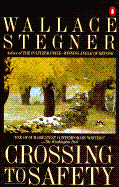
I don't know much about loss. I know what longing is, but with loss, I'm a novice. I've had a few grandparents pass away during my life, but no uncles, cousins or parents. A couple friends committed suicide within a couple of years of one another. I guess that's the closest to loss that I've come that has seriously affected me. But I didn't love them so the loss seems vacant almost. I was mad at them more than anything and I still am. Stll, this loss is death and I know it can take on any personality, any form. Loss is a shapeshifter.
For the first half of Wallace Stegner's Crossing to Safety I was fooled by the author into believing I was reading a striking book on common experiences. Stegner's narrator, Larry Morgan, was a writer teaching at a Wisconsin college when he and his wife Sally meet the two people that will irrevocably change their lives. I have heard of people's lives being changed by a dramatic or traumatic event-a death, a divorce, a winning lottery ticket, a failed exam. I never heard of of anybody's life but ours being changed by a dinner party.
A lifelong friendship is formed that night, the bonds of which are never broken. A truly remarkable 4-way relationship. But it's the unexpected event that takes place on a harmless camping trip that has kept me thinking and rethinking what love and loss mean. Sally is stricken with Polio. The jubilant 30-year old becomes reliant on crutches and braces for the rest of her life. That's in the late 1930's. This to me is like a loss of life. Not to Sally, or Larry for that matter. Without function of my body parts, how could I live the life I had? Could I live a different one, one that would be dictated by my ability to get around, slowly and painfully with crutches and braces? But Sally never seems to hesitate. As readers we aren't brought into the years of struggle she must have gone through. Instead, Stegner simply refers to it in passing a few times. She has a sick body, but a lively spirit type of thing.
Now in the 1970's, Larry and Sally are visiting the Lang's on their much beloved estate in Vermont. It's the last time all four will be together. And they know it. Charity Lang is dying of cancer and has called the Morgans there to have her entire family around. Planning her last breaths till the end, just like she planned and scheduled the rest of her life and everyone else around her.
It was her death. She had a right to handle it her own way. But I felt sorry for Sid, a reluctant stoic, and I dreaded the coming hour or two when I would be alone with him. I was the person he was most likely to confide in, and I feared his confidence and had on tap no word of consolation or comfort. It crossed my mind, while I sat waiting on the lawn above the green and blue view, that down under his anguish and panic he might even look forward to her death as a release. Then I decided not. Charity had mastered him, but also she supported him. She not only ran his life, she was his life. I didn't like to think what would happen to him with her gone. His resistance and resentment were only expressions of his dependence. Sally resented her crutches, too, but without them she would have been hardly more than a broken stick with eyes.
It's this eventual loss that I've yet to experience and I'm in no rush to witness. But it encompasses humanity in tow relationships between husbands and wives. Is this passing something any of us can prepare for? Don't we block this inevitability out of our minds, banish death to the darkness of our knowing? At least I try to.
At times Stegner scared me with his frankness...with the truth. It's uncharacteristic to read such things about love and life. It's all too real, a little to close for comfort, but Stegner steps over the boundary of conventional literature and christens the reader with the true word of truth.
Tuesday, July 11, 2006
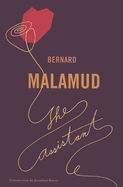
If I had to describe Malamud's The Assistant after the first 100 pages or so, I'm certain my summary would have failed miserably. It is not a story about deprivation or about loneliness. It is not a story about lost chances and desperation. It is a story about survival and hope. It is a story about redemption and aspiration. The heart of the novel is how we all struggle to survive in the world we live in, in the world that has formed around us. Sometimes it's because of our own actions, but oftentimes, it's the environment that shapes our world and darkens the doorways. But we always have hope. Morris Bober had hope. Helen Bober had hope. Frank Alpine had hope. And in times of disaster, when the lighted path fails to show itself, hope is our Beatrice. Whether it's Frank's hope to repay a debt that has sunken his soul or whether it's Helen's hope to go to college and better her life. This hope gets us through the long impenetrable months of solitude and loneliness.
Waking, she fought an old distrust of the broken-faced stranger, without success. The stranger had changed, grown unstrange. That was the clue to what was happening to her. One day he seemed unknown, lurking at the far end of an unlit cellar; next he was standing in sunlight, a smile on his face, as if all she knew of him and all she didn't, had fused into a healed and easily remembered whole.
Malamud gave Frank the passion and Helen the feelings and thoughts. The dichotomy of characters intriguing...partly because it goes against stereoptypes, but mostly because it gave the book movement. The characters, though sometimes lacking vigor to struggle through life, became people I knew. They were me and I was them. Part Frank, part Helen, part Morris. Malamud captured my humanity in a few characters in a couple hundred pages. Knowing my thoughts and writing what I would have said, Malamud is the voice of the street of New York and Boston. Moscow and Chicago. He knows us all so well.
Just finished:
Bernard Malamud The Assistant
Now reading:
Wallace Stegner Crossing to Safety
Plutarch Makers of Rome
Monday, July 10, 2006
Almost four weeks away from the blogosphere. My hiatus began with computer problems, making posts became impossible. Then one week of not blogging turned into two weeks of lounging and trying to enjoy the summer. I took from the midsummer what I could and my reading and writing ways are back. I only read Walker Percy's The Moviegoer and Michael Dirda's Book by Book: Notes on Reading and Life.
My summer reading books are piling up beneath my desk, ever closer to toppling over and scattering under the bed. Listening to the MLB All-Star Home Run contest, I'm trying to finish Bernard Malamud's The Assistant. I always thought it was about a young professional in the corporate world. Don't ask why. I just did. I couldn't have been further from the truth and that's a good thing. Malamud has painted a painfully real portrayal of not just urban life, but life. A struggling grocer in New York, Morris Bober, is mugged by two assailants. Alone, this act is nothing too unusual. However, one of the thieves comes back to help the grocer, to repay what he stole. He doesn't tell the grocer, or the grocer's wife that he was one of the robbers, but he works hard in the store paying the money back, but continuing to pilfer here and there.
It's a story of redemption, religion and love. Because not only does Frank Alpine try and redeem himself, but he falls for Morris's daughter Helen. For any male reader, Helen is the ideal.
He asked her what book she was reading.
The Idiot. Do you know it?
No. What's it about?
It's a novel.
I'd rather read the truth, he said.
It is the truth.
This is Helen. This is my Helen.
Now reading:
Bernard Malamud The Assistant
Plutarch The Makers of Rome
My summer reading books are piling up beneath my desk, ever closer to toppling over and scattering under the bed. Listening to the MLB All-Star Home Run contest, I'm trying to finish Bernard Malamud's The Assistant. I always thought it was about a young professional in the corporate world. Don't ask why. I just did. I couldn't have been further from the truth and that's a good thing. Malamud has painted a painfully real portrayal of not just urban life, but life. A struggling grocer in New York, Morris Bober, is mugged by two assailants. Alone, this act is nothing too unusual. However, one of the thieves comes back to help the grocer, to repay what he stole. He doesn't tell the grocer, or the grocer's wife that he was one of the robbers, but he works hard in the store paying the money back, but continuing to pilfer here and there.
It's a story of redemption, religion and love. Because not only does Frank Alpine try and redeem himself, but he falls for Morris's daughter Helen. For any male reader, Helen is the ideal.
He asked her what book she was reading.
The Idiot. Do you know it?
No. What's it about?
It's a novel.
I'd rather read the truth, he said.
It is the truth.
This is Helen. This is my Helen.
Now reading:
Bernard Malamud The Assistant
Plutarch The Makers of Rome
Friday, June 23, 2006
After reading Stefanie's post on Proust I thought that I'd post the famous Proust Questionaire.
Here are Proust's answers at 7:
What do you regard as the lowest depth of misery? To be separated from Mama
Where would you like to live? In the country of the Ideal, or, rather, of my ideal
What is your idea of earthly happiness? To live in contact with those I love, with the beauties of nature, with a quantity of books and music, and to have, within easy distance, a French theater
To what faults do you feel most indulgent? To a life deprived of the works of genius
Who are your favorite heroes of fiction? Those of romance and poetry, those who are the expression of an ideal rather than an imitation of the real
Who are your favorite characters in history? A mixture of Socrates, Pericles, Mahomet, Pliny the Younger and Augustin Thierry
Who are your favorite heroines in real life? A woman of genius leading an ordinary life
Who are your favorite heroines of fiction? Those who are more than women without ceasing to be womanly; everything that is tender, poetic, pure and in every way beautiful
Your favorite painter? Meissonier
Your favorite musician? Mozart
The quality you most admire in a man? Intelligence, moral sense
The quality you most admire in a woman? Gentleness, naturalness, intelligence
Your favorite virtue? All virtues that are not limited to a sect: the universal virtues
Your favorite occupation? Reading, dreaming, and writing verse
Who would you have liked to be? Since the question does not arise, I prefer not to answer it. All the same, I should very much have liked to be Pliny the Younger.
Seven years later, age 20:
Your most marked characteristic? A craving to be loved, or, to be more precise, to be caressed and spoiled rather than to be admired
The quality you most like in a man? Feminine charm
The quality you most like in a woman? A man's virtues, and frankness in friendship
What do you most value in your friends? Tenderness - provided they possess a physical charm which makes their tenderness worth having
What is your principle defect? Lack of understanding; weakness of will
What is your favorite occupation? Loving
What is your dream of happiness? Not, I fear, a very elevated one. I really haven't the courage to say what it is, and if I did I should probably destroy it by the mere fact of putting it into words.
What to your mind would be the greatest of misfortunes? Never to have known my mother or my grandmother
What would you like to be? Myself - as those whom I admire would like me to be
In what country would you like to live? One where certain things that I want would be realized - _and where feelings of tenderness would always be reciprocated_. [Proust's underlining]
What is your favorite color? Beauty lies not in colors but in thier harmony
What is your favorite flower? Hers - but apart from that, all
What is your favorite bird? The swallow
Who are your favorite prose writers? At the moment, Anatole France and Pierre Loti
Who are your favoite poets? Baudelaire and Alfred de Vigny
Who is your favorite hero of fiction? Hamlet
Who are your favorite heroines of fiction? Phedre (crossed out) Berenice
Who are your favorite composers? Beethoven, Wagner, Shuhmann
Who are your favorite painters? Leonardo da Vinci, Rembrandt
Who are your heroes in real life? Monsieur Darlu, Monsieur Boutroux (professors)
Who are your favorite heroines of history? Cleopatra
What are your favorite names? I only have one at a time
What is it you most dislike? My own worst qualities
What historical figures do you most despise? I am not sufficiently educated to say
What event in military history do you most admire? My own enlistment as a volunteer!
What reform do you most admire? (no response)
What natural gift would you most like to possess? Will power and irresistible charm
How would you like to die? A better man than I am, and much beloved
What is your present state of mind? Annoyance at having to think about myself in order to answer these questions
To what faults do you feel most indulgent? Those that I understand
What is your motto? I prefer not to say, for fear it might bring me bad luck.
Yes, 7 and 20. It almost doesn't seem real, that someone, let alone at such young and impressionable ages, could answer these questions with such perfection.
I'd post my responses, but then people may see me for who I really am and that may be better left unseen.
Here are Proust's answers at 7:
What do you regard as the lowest depth of misery? To be separated from Mama
Where would you like to live? In the country of the Ideal, or, rather, of my ideal
What is your idea of earthly happiness? To live in contact with those I love, with the beauties of nature, with a quantity of books and music, and to have, within easy distance, a French theater
To what faults do you feel most indulgent? To a life deprived of the works of genius
Who are your favorite heroes of fiction? Those of romance and poetry, those who are the expression of an ideal rather than an imitation of the real
Who are your favorite characters in history? A mixture of Socrates, Pericles, Mahomet, Pliny the Younger and Augustin Thierry
Who are your favorite heroines in real life? A woman of genius leading an ordinary life
Who are your favorite heroines of fiction? Those who are more than women without ceasing to be womanly; everything that is tender, poetic, pure and in every way beautiful
Your favorite painter? Meissonier
Your favorite musician? Mozart
The quality you most admire in a man? Intelligence, moral sense
The quality you most admire in a woman? Gentleness, naturalness, intelligence
Your favorite virtue? All virtues that are not limited to a sect: the universal virtues
Your favorite occupation? Reading, dreaming, and writing verse
Who would you have liked to be? Since the question does not arise, I prefer not to answer it. All the same, I should very much have liked to be Pliny the Younger.
Seven years later, age 20:
Your most marked characteristic? A craving to be loved, or, to be more precise, to be caressed and spoiled rather than to be admired
The quality you most like in a man? Feminine charm
The quality you most like in a woman? A man's virtues, and frankness in friendship
What do you most value in your friends? Tenderness - provided they possess a physical charm which makes their tenderness worth having
What is your principle defect? Lack of understanding; weakness of will
What is your favorite occupation? Loving
What is your dream of happiness? Not, I fear, a very elevated one. I really haven't the courage to say what it is, and if I did I should probably destroy it by the mere fact of putting it into words.
What to your mind would be the greatest of misfortunes? Never to have known my mother or my grandmother
What would you like to be? Myself - as those whom I admire would like me to be
In what country would you like to live? One where certain things that I want would be realized - _and where feelings of tenderness would always be reciprocated_. [Proust's underlining]
What is your favorite color? Beauty lies not in colors but in thier harmony
What is your favorite flower? Hers - but apart from that, all
What is your favorite bird? The swallow
Who are your favorite prose writers? At the moment, Anatole France and Pierre Loti
Who are your favoite poets? Baudelaire and Alfred de Vigny
Who is your favorite hero of fiction? Hamlet
Who are your favorite heroines of fiction? Phedre (crossed out) Berenice
Who are your favorite composers? Beethoven, Wagner, Shuhmann
Who are your favorite painters? Leonardo da Vinci, Rembrandt
Who are your heroes in real life? Monsieur Darlu, Monsieur Boutroux (professors)
Who are your favorite heroines of history? Cleopatra
What are your favorite names? I only have one at a time
What is it you most dislike? My own worst qualities
What historical figures do you most despise? I am not sufficiently educated to say
What event in military history do you most admire? My own enlistment as a volunteer!
What reform do you most admire? (no response)
What natural gift would you most like to possess? Will power and irresistible charm
How would you like to die? A better man than I am, and much beloved
What is your present state of mind? Annoyance at having to think about myself in order to answer these questions
To what faults do you feel most indulgent? Those that I understand
What is your motto? I prefer not to say, for fear it might bring me bad luck.
Yes, 7 and 20. It almost doesn't seem real, that someone, let alone at such young and impressionable ages, could answer these questions with such perfection.
I'd post my responses, but then people may see me for who I really am and that may be better left unseen.
Subscribe to:
Posts (Atom)